Steven's nameplate
A desk nameplate for Steven Moss of the Astera Institute, built three ways. Each revision is a small experiment with its own question, method, result and files, published the day it was made. The failures stay on the page next to the fixes.
This is Rev 2, loaded when it scrolls into view. The guided walkthrough starts on its own; the PCB, Schematic and Parts tabs are live. Open it full screen.
The three revisions
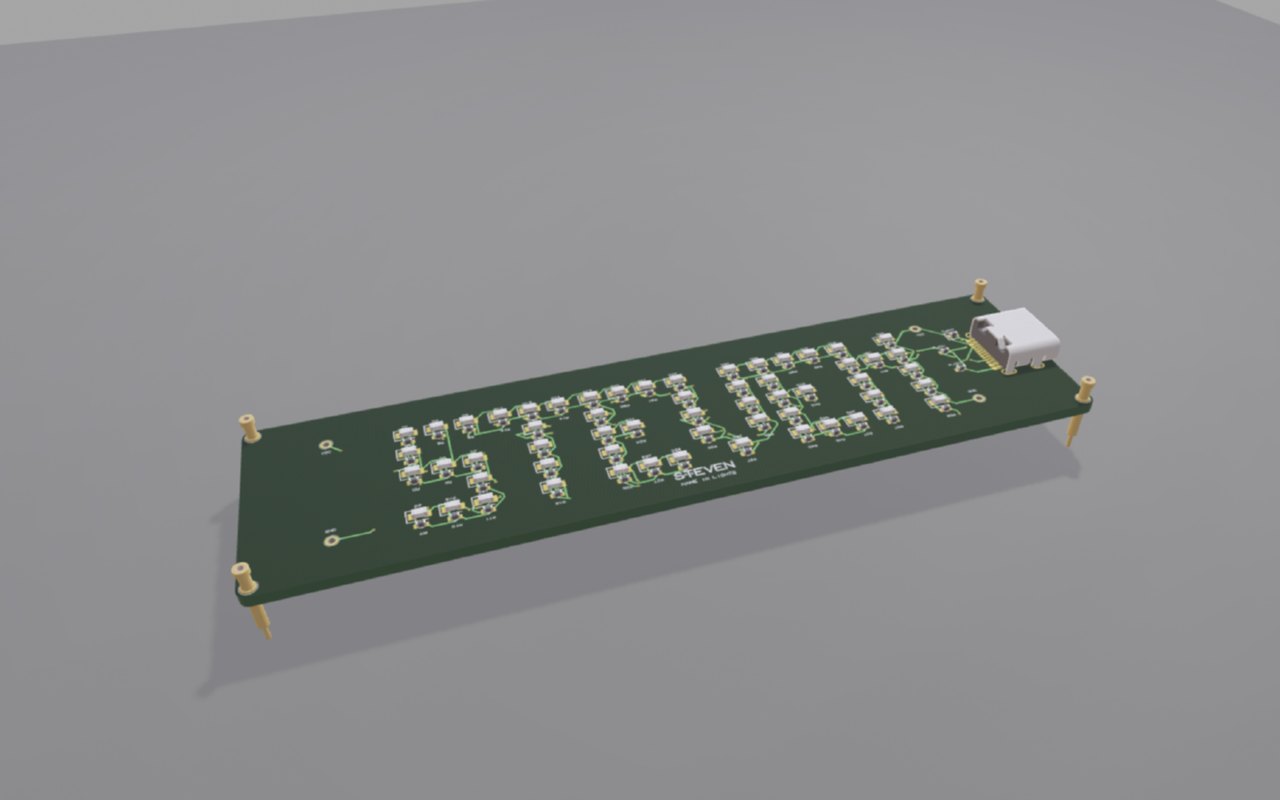
Rev 1: 3 x 5 LED dot matrixsuperseded
58 white LEDs spell STEVEN, powered from an iPhone charger. 0 DRC errors and every net connected after a layout sweep that is documented in full, including the router's silent opens. Failed as typography: three columns cannot draw an N.
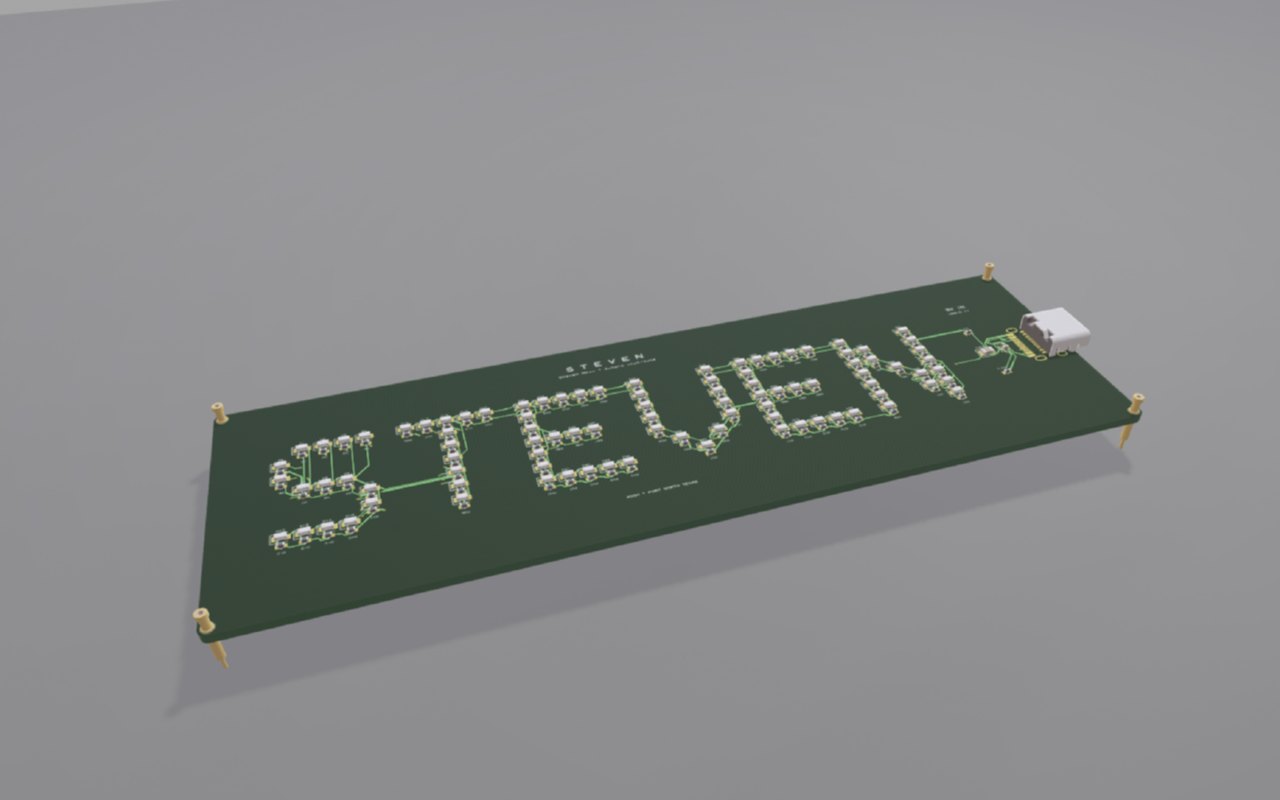
Rev 2: 5 x 7 LED dot matrixdesigned
94 white LEDs in a 5 x 7 font, so the N has a real diagonal. Every part is a stocked Adom Basic Part with an MPN, the draw is about 400 mA, and the board resizes itself from one line of text. 0 DRC errors, 98 of 98 nets connected.
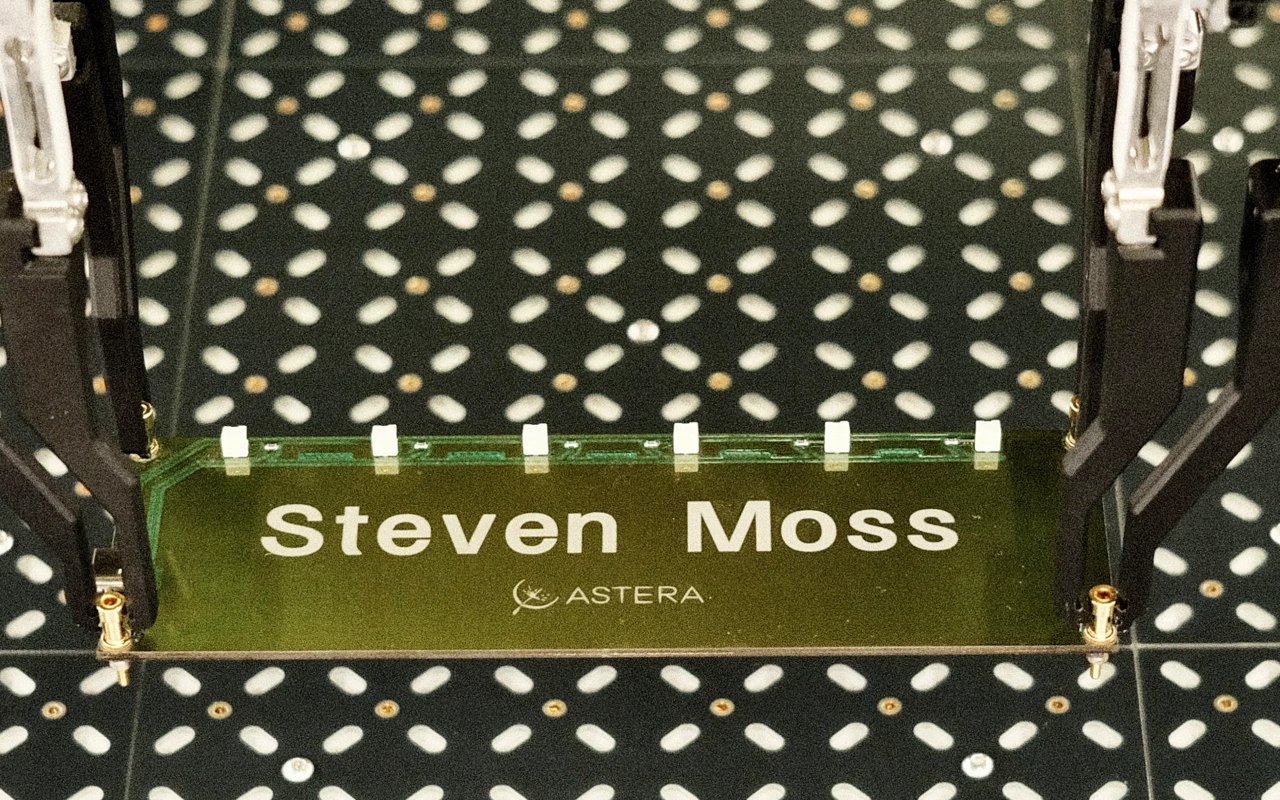
Rev 3: name laser-ablated into the silkscreenmade
The plate Steven receives. Adonis Lysandrou's standard blank board (Fusion 360, six side-firing LEDs), with "Steven Moss" on the first line and the Astera logo on the second, ablated into the soldermask by the workcell's UV laser from a Nameplate Generator job. Per-person work drops from a new PCB to a laser job.
What changed, and why
| Rev 1 | Rev 2 | Rev 3 | |
|---|---|---|---|
| How the name is made | 58 LEDs, 3 x 5 font | 94 LEDs, 5 x 7 font | Laser-ablated silkscreen, lit by 6 edge LEDs |
| Board | 98.4 x 26.4 mm | 136.4 x 44.4 mm | 160 x 48 mm |
| Designed with | tscircuit 0.0.1753, AI | tscircuit 0.0.2375, AI | Fusion 360 Electronics, human |
| Parts | generic, no MPNs | all stocked, with MPNs | OSRAM, GCT, Royalohm, with MPNs |
| Draw at 5 V | about 520 mA | about 400 mA | 6 LEDs at 100 ohm |
| New work per name | a new PCB | a new PCB (one line of code) | a new laser job |
| Status | superseded | verified, not fabricated | made, handed over in DC |
| Lesson | DRC passes a board with dead nets; the N needs 5 columns | a newer router, plus a geometric connectivity check, is what got a clean board | one board for everyone; the per-person work is a laser job |
Open science
This page is a worked example, for the Astera Institute, of how Adom's AI publishes an experiment as soon as it exists. The full scorecard lists every rule and where this page meets it, meets it partly, or does not yet.
| Astera asks for | Here |
|---|---|
| Publish when ready for reuse, not when a paper is written | each revision published the day it was made |
| Code MIT or more open | yes, MIT |
| Data CC0 | yes |
| Protocols and text CC BY | yes, CC BY 4.0; each revision has a reproduce section |
| Funder with ROR ID | U.S. NSF, ROR 021nxhr62 |
| Negative results | every failed router layout |
| Register of outputs | outputs.csv with SHA-256 per file |
| DOI and Zenodo deposit | not yet, the gap our proposed pipeline closes |
| Code on GitHub | partial, git on the wiki, no GitHub mirror |
Files and licenses
- Board source and scripts (
rev*/source/): MIT - Data (
circuit.json, 3D models, gerbers, BOMs): CC0 1.0 - Write-ups, photos, artwork: CC BY 4.0
- Every output with its SHA-256:
outputs.csv. How to cite:CITATION.cff. The brief and every request:plan.md
Provenance
Requested by John Lauer (PI, Adom Industries, NSF PCL Test Bed node, Fort Worth). Revs 1 and 2 designed by Claude (Anthropic) in Adom's Hydrogen desktop with tscircuit and adom-tsci. Rev 3 board designed and ablated by Adonis Lysandrou; laser job generator by Aditya Angajala. The node is funded by the U.S. National Science Foundation (ROR 021nxhr62). Made for the Astera Institute (ROR 00ydx1s47), which did not fund it.