Rev 1: 3 x 5 LED dot matrix
The first attempt. An AI designed a desk nameplate that spells STEVEN in 58 white LEDs, powered from an iPhone charger through a USB-C port on the right edge. It works electrically. It fails as typography: the N reads as an H. That failure is the reason Rev 2 exists.
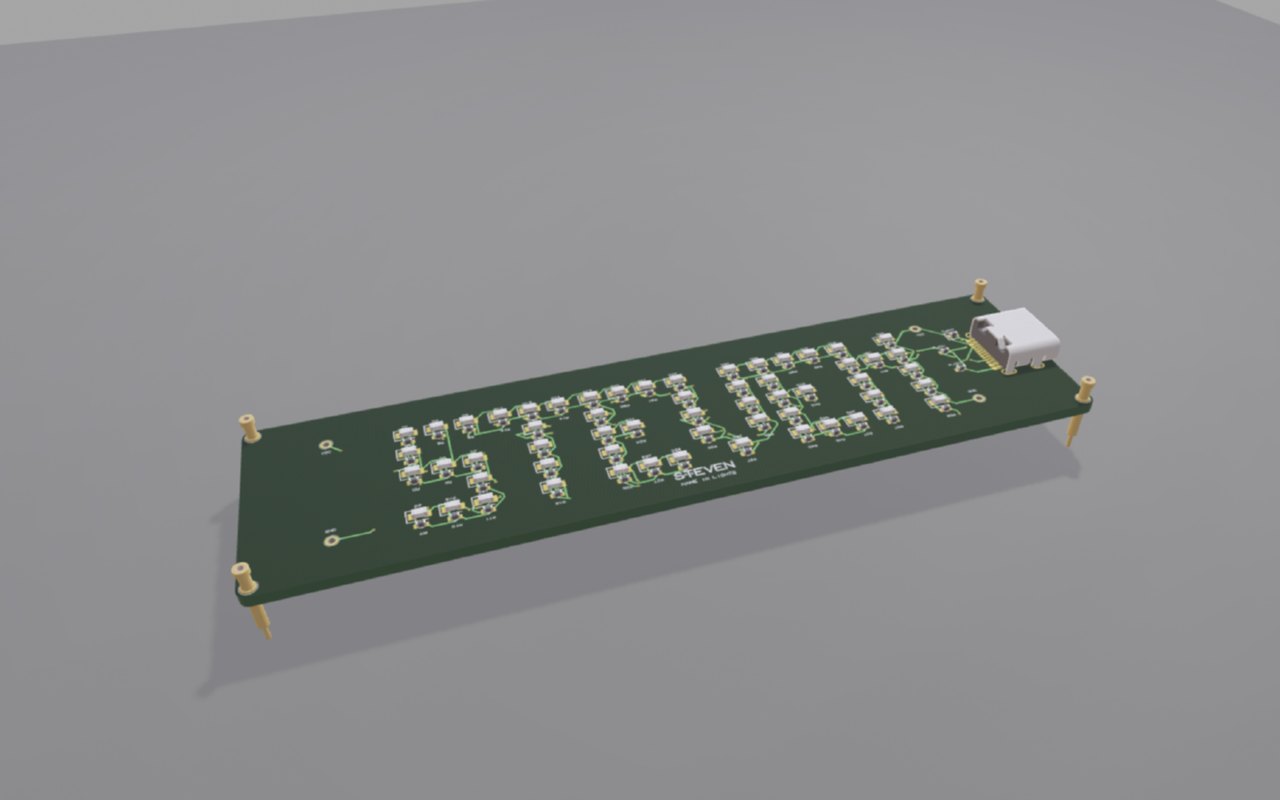
| Status | Designed and verified in software. Not fabricated. |
| Date | 2026-09-11 |
| Board | 98.4 x 26.4 mm, 2 layer FR4, Adom molecule 96x24 nominal, medium machine pins |
| Letters | 58 LEDs, 3 x 5 pixel font, 3.5 mm pixel pitch, 4 mm letter gap, 62 mm of text |
| Power | USB-C on the east edge, 5 V, about 520 mA with every LED lit |
| Result | 0 DRC errors, 62 of 62 nets connected, USB-C geometry inside the guide's reference window |
| Outcome | Superseded by Rev 2. Kept as the record of what was tried first. |
The board, live
Orbit, zoom, hover any part for its refdes and net, x-ray the copper with the Nets panel, or run the guided walkthrough. The PCB, Schematic and Parts tabs across the top are live too. Open full screen.
The question this revision asked
Can an AI, given one sentence, produce a manufacturable board that puts a person's name in lights and runs off a phone charger, using the same pipeline (tscircuit, the Adom molecule library, the adom-tsci viewer) that produced earlier Adom nameplates?
The prompt, verbatim, as typed by John Lauer on 2026-09-11:
hey, we want to put Steven's name in lights on a pcb nameplate. put a usbc connector on the right side of the board so he can plug it into his iphone. use adom-tsci and open it in the webview when done.
Method
- Template. The AI started from
vijay-nameplate, an earlier 3 x 5 LED nameplate on the same stack, and changed the word, the board size and the connector position. The 3 x 5 font came with it unexamined. That inherited assumption is the defect this revision records. - Board size. Six letters at 3 mm pitch need 56 mm of text plus about 13 mm reserved for the
USB-C receptacle and its support parts, which does not fit the
80x24molecule Vijay used. It moved up to96x24(98.4 x 26.4 mm real outline). - USB-C. The
UsbCReceptaclewrapper was copied byte-for-byte from the adom-usbc guide and placed withmount="east"atpcbX = W/2 - 4 = 44. Two 4.7 kohm CC pulldowns (Rd) make a USB-C charger turn VBUS on. A 100 nF capacitor bypasses VBUS. - Build, then verify geometry, not just DRC. Every build ran
tsci build,adom-tsci lint, and a new union-find connectivity check (source/scripts/check-connectivity.py) that follows copper pad to trace to via to pad, layer by layer. - Iterate on layout until the router produced a fully connected board. See Results.
Results
Negative results: the router's silent opens
The first build passed tscircuit's own checks for most nets, yet the board did not work. The
autorouter (tscircuit 0.0.1753) sometimes ends a bottom-layer trace directly under a top-layer
pad with no via. The trace carries an end_pcb_port_id, so both tscircuit and adom-tsci lint
count it as routed. Only the geometric check sees that nothing connects.
Every layout tried, in order:
| Layout | DRC errors | Nets split into islands |
|---|---|---|
| 3 mm pitch, resistor 1.5 mm below LED (the Vijay layout) | 6 | 3 |
| same, resistors rotated 180 degrees | 2 | 2 |
| 3.5 mm pitch, resistor 1.5 mm below | 0 | 1 |
| 3.5 mm pitch, resistor 1.75 mm below | 0 | 1 |
| 3.5 mm pitch, 1.9 mm / 4.5 mm letter gap / y offset 6.5 (three variants) | 0 to 342 | 1 to 2 |
router preset auto_cloud |
n/a | 59 |
router preset sequential_trace |
build fails on the molecule | n/a |
| 3.5 mm pitch, resistor 1.6 mm below, rotated 180 degrees | 0 | 0 (shipped) |
The same checker, run against the shipped vijay-nameplate this was copied from, found one real
open there too (R24 and R26 isolated from VBUS). That finding was reported, not fixed, since it
is a different board.
Final numbers
| Check | Value |
|---|---|
| Components | 128: 58 LEDs, 60 resistors, 1 capacitor, 1 USB-C, 4 test contacts, 4 machine pins |
| Routing | 186 routed traces for 188 declared (the 2 are the merged same-net USB-C tabs), 78 vias |
DRC errors in circuit.json |
0 |
| Connectivity | 62 of 62 nets, each one island |
| USB-C pad gap to edge | 7.00 mm (guide window 5 to 8) |
| USB-C anchor hole gap to edge | 1.83 mm (guide: more than 0.8) |
| USB-C mouth overhang | 2.31 mm (guide window 2 to 3) |
| USB-C pads / holes | 12 / 6 |
What went wrong: the N
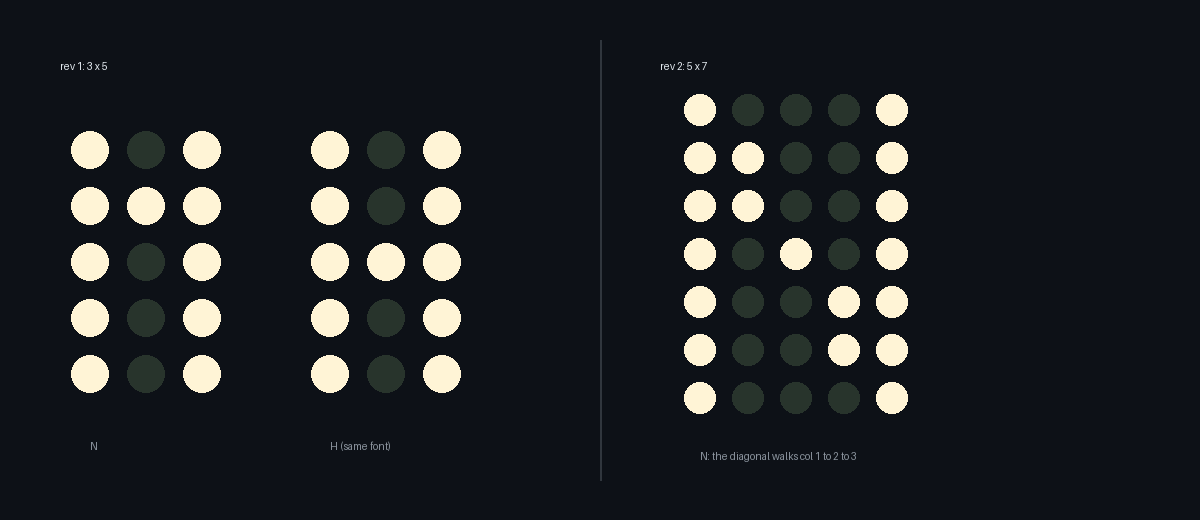
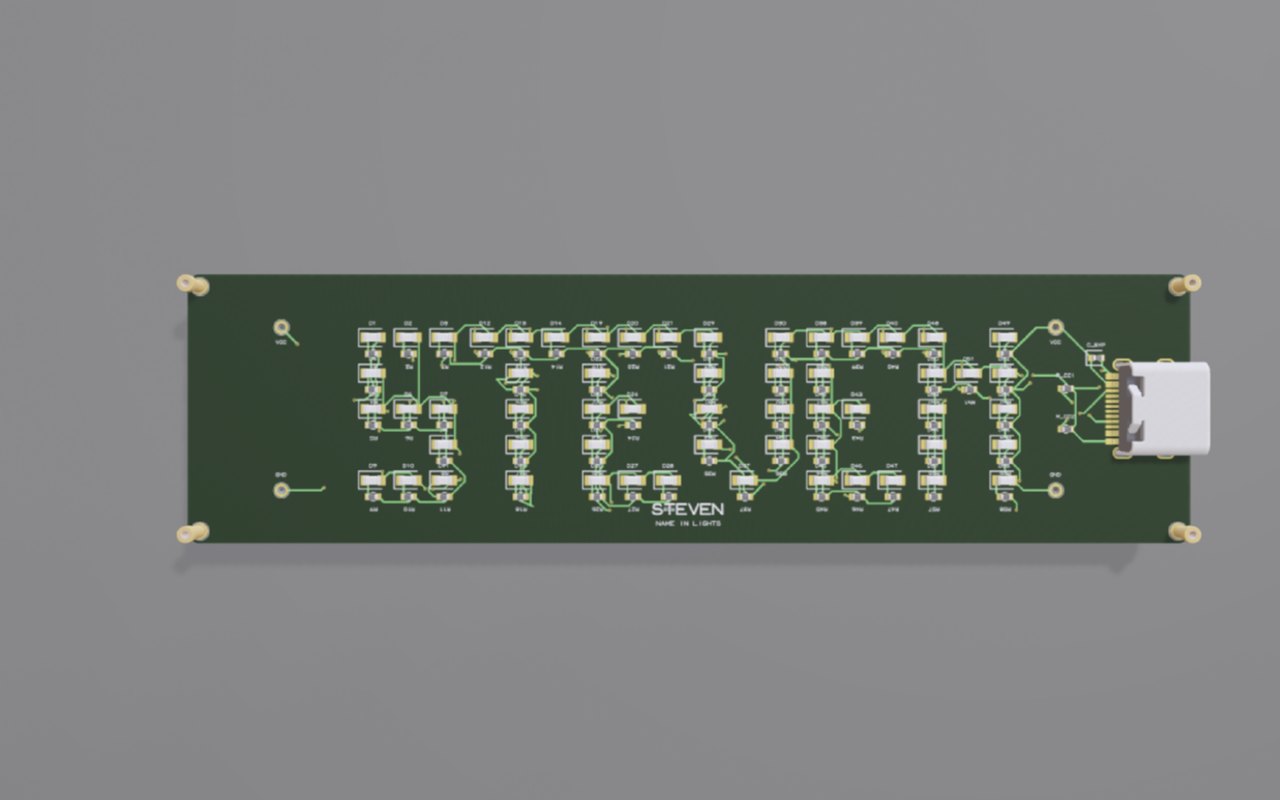
Three columns give an N nowhere to put its diagonal. The glyph becomes two verticals and a bar near the top, which reads as an H. Seen in the top view, STEVEN reads closer to STEVEH.
Other known gaps, all fixed in Rev 2:
- LEDs and resistors are generic (
color="white",220 ohm) with no manufacturer part numbers. The BOM inrev1/fab/bom.csvsays so. A fab house could not assemble it without substitution. - 520 mA exceeds the 500 mA a USB-C source guarantees without negotiation. Most phone chargers advertise 1.5 A or 3 A through CC, so it would likely light, but it is out of spec.
- The texture renderer shows the board at 2048 px, and the served GLB had to be checked for a known cache bug (a 0-vertex USB-C body). It was clean: 46,644 vertices.
Reproduce this experiment
Tools used
| Tool | Version | What it did here | Get it |
|---|---|---|---|
| Claude Code, in Adom's Hydrogen desktop | Claude Opus 5 | The AI that wrote the board, ran every build and check, and wrote this page | Adom Hydrogen |
| bun | 1.4.0 | JavaScript runtime that runs tscircuit | curl -fsSL https://bun.sh/install | bash |
| tscircuit, @tscircuit/cli | 0.0.1753 / 0.1.1382 | Board description in TSX, autorouter, DRC, gerber and GLB export | bun install --frozen-lockfile (pinned in bun.lock) |
| @tsci/adom-inc.molecule, @tsci/adom-inc.library | 1.1.15 / 1.1.14 | Adom molecule outline and corner machine pins | same, through the .npmrc registry npm.tscircuit.com |
| adom-tsci | 1.4.24 | Live 3D / PCB / schematic preview, lint, gerber export, walkthrough, the viewer embedded on this page |
adom-wiki pkg install adom/adom-tsci |
| adom-usbc guide | ships with adom-tsci | The USB-C wrapper (copied verbatim) and the edge checks | ~/.claude/skills/adom-tsci/guides/adom-usbc.md |
scripts/check-connectivity.py |
this page | Geometric pad-trace-via connectivity per net; catches opens DRC misses | Python 3 standard library |
scripts/sweep.sh |
this page | Parallel layout sweep, reports DRC errors and split nets per variant | bash + bun |
scripts/make-bom.py |
this page | Real BOM and pick-and-place spliced into the gerber zip | Python 3 standard library |
| glb-datauri-textures.mjs, glb-make-zup.mjs | adom-tsci page | Makes the 3D models load in the wiki's sandbox and lie flat | https://wiki.adom.inc/adom/adom-tsci/render/scripts/ |
| pup (Adom Bridge) | The renders on this page, shot in a background browser | adom-bridge pup_open_window |
|
| adom-wiki | Publishing this page | preinstalled on Adom containers |
What actually ran, in order
- Read the adom-tsci and adom-usbc guides, then copied
vijay-nameplate(lib, lockfile, node_modules) to a new project and changed the word, board size and connector position. bunx tsci build lib/index.tsx --glbs --svgs, then read every*_errorincircuit.jsonand ranadom-tsci lint.- Wrote
scripts/check-connectivity.pyafter seeing traces reported as routed that connected nothing, and checked it against a known-good board (bill-nameplate: 0 split). - Swept layouts (the table above) by editing
GRID,LETTER_GAP,yOffand the resistor offset, rebuilding each in a scratch copy, until one came back 0 errors and 0 split. - Ran the adom-usbc edge check (pad gap, hole gap, overhang, pad and hole counts).
adom-tsci start . --texture-resolution 2048, checked the console for a USB-C placeholder, compared the served GLB's J1 vertex count with the tscircuit-built one, then took the body-on and body-off USB-C screenshots and read them.adom-tsci export --format gerbers, thenscripts/make-bom.pyto replace the empty BOM.
Rebuild it yourself
Everything needed is in rev1/source/. From a Linux or macOS shell with
bun installed:
adom-wiki repo download adom/steven-led-nameplate --extract ./steven
cd steven/rev1/source
bun install --frozen-lockfile          # pins tscircuit 0.0.1753, @tscircuit/cli 0.1.1382
bunx tsci build lib/index.tsx --glbs --svgs
python3 scripts/check-connectivity.py  # expect: 62 nets checked, 0 split
Expected: 0 entries whose type ends in _error in dist/lib/index/circuit.json, 186 routed
traces. The autorouter is deterministic for a fixed input and fixed package versions; a different
tscircuit version routes differently (Rev 2 shows how much).
To preview interactively: adom-tsci start . (Adom's viewer), or open
the Rev 1 live viewer on this page.
To fabricate: rev1/fab/gerbers.zip holds copper, mask, silkscreen, paste, outline and drill
files plus bom.csv and pick_and_place.csv. Do not fabricate Rev 1; build Rev 2.
Outputs
| File | What it is | License |
|---|---|---|
rev1/source/lib/index.tsx |
The board, as tscircuit TSX | MIT |
rev1/source/lib/UsbCReceptacle.tsx |
USB-C wrapper, verbatim from the adom-usbc guide | MIT |
rev1/source/scripts/check-connectivity.py |
Geometric net connectivity check | MIT |
rev1/source/package.json, bun.lock |
Exact dependency pins | MIT |
rev1/viewer/circuit.json |
Complete circuit description (netlist, placement, routing) | CC0 |
rev1/viewer/3d.glb |
3D model, 2048 px board texture | CC0 |
rev1/fab/gerbers.zip |
Fabrication files | CC0 |
rev1/fab/bom.csv, pick_and_place.csv |
Assembly data | CC0 |
| this document | Method, results, negative results | CC BY 4.0 |
Provenance
| Requested by | John Lauer, Adom Industries (PI, NSF PCL Test Bed node, Fort Worth) |
| Designed by | Claude Opus 5 (Anthropic), running in Claude Code inside Adom's Hydrogen desktop |
| Toolchain | tscircuit 0.0.1753, @tscircuit/cli 0.1.1382, @tsci/adom-inc.molecule 1.1.15, @tsci/adom-inc.library 1.1.14, adom-tsci 1.4.24, bun 1.4.0 |
| Template | vijay-nameplate (Adom, 2026-09-11) |
| Human review | John Lauer viewed the live 3D preview and asked for the font change that became Rev 2 |
Contributor roles (CRediT): John Lauer, conceptualization and supervision. Claude (AI), design, software, validation, writing.
Funding
Adom Industries' electronics prototyping node is funded by the U.S. National Science Foundation Programmable Cloud Laboratories (PCL) Test Bed program (ROR 021nxhr62). This nameplate was made as a worked example of open publishing for the Astera Institute (ROR 00ydx1s47); Astera did not fund it.