Rev 3: the name laser-ablated into the silkscreen
A different experiment, not a refinement. Revs 1 and 2 build the letters out of LEDs, so every name is a new circuit that has to be designed, routed and verified. Rev 3 keeps one circuit for everyone: a standard blank board with six side-firing LEDs that light the whole face, and the name is etched into it afterwards by the laser in Adom's workcell. The per-person work drops from a new PCB to a new laser job.
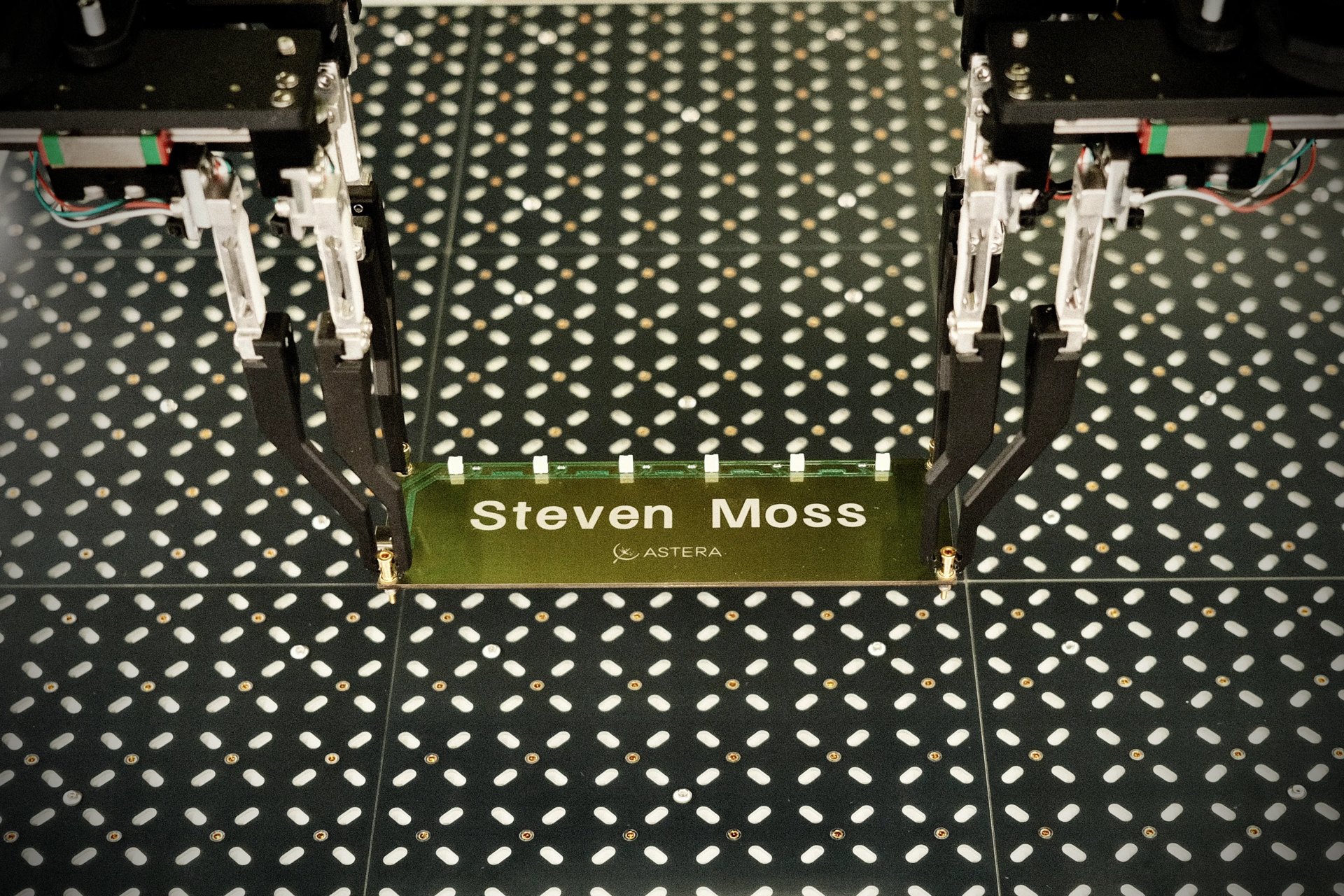
This is the plate Steven receives, shown at the NSF PCLNet Summit in Washington, DC.
The plate as made
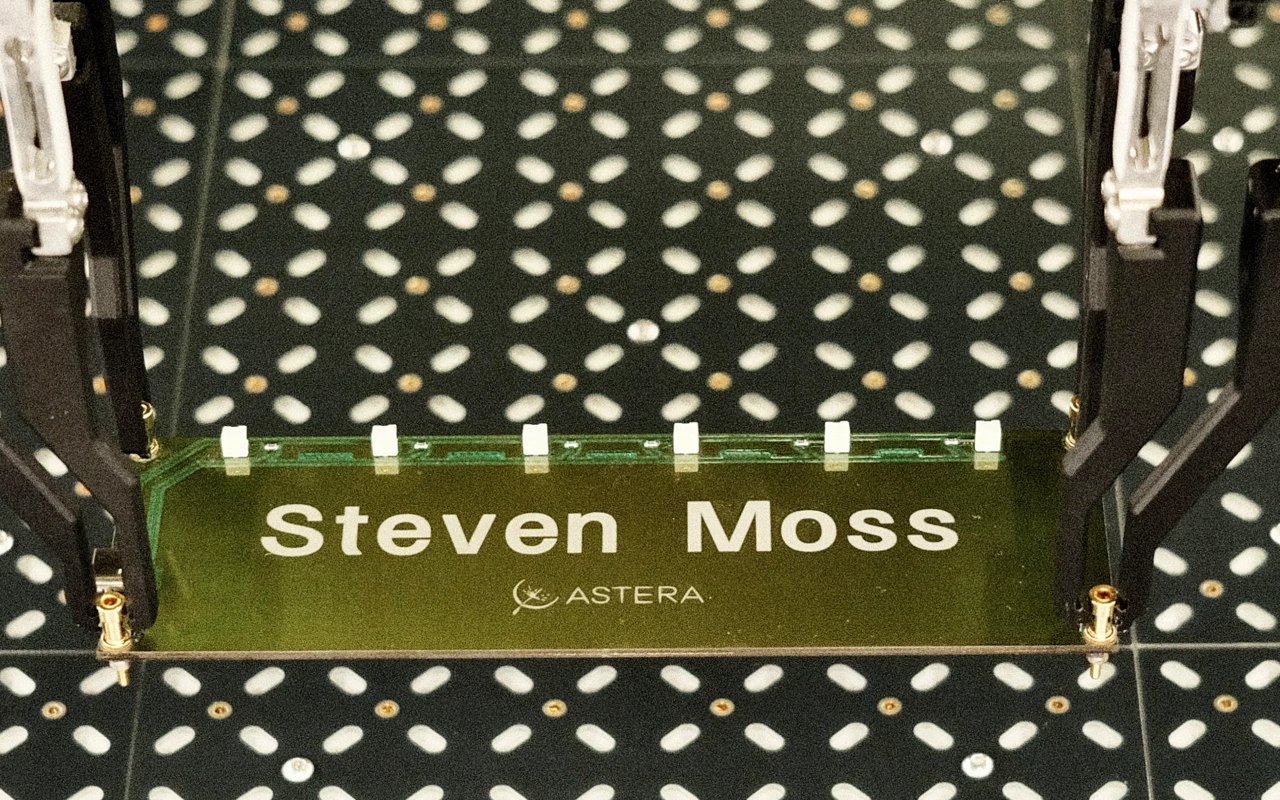
"Steven Moss" on the first line, the Astera logo on the second, ablated through the soldermask of the blank. The six side-firing LEDs along the top edge light the board face. Photo: Kale Weimer, Adom Industries, 2026-09-23, the plate held by a workcell's grippers on the Adom scaffold it was made to fixture into.
Steven's plate, live
The finished plate: Adonis's blank board with Steven's artwork on the face, full name on the first line, the Astera mark and wordmark on the second, matching the plate as made. Orbit it; the etched artwork is its own layer ("Etched name") you can switch off to see the bare blank. Open full screen. The blank on its own is on Adonis's page.
| Status | Made. Steven's plate is finished and handed over at the NSF PCLNet Summit in DC. |
| Board designer | Adonis Lysandrou, Adom Industries |
| Board | Nametag Blank Large LED, 160 x 48 mm, 2 layer, 1.6 mm FR4, 35 um copper |
| Source | Fusion 360 Electronics, revision of 21 Sep 2026 (Fusion v40), published as adonis/nametag-blank-large-led v1.2.0 |
| Light | 6 x ams OSRAM LW A6SG-V2BA-FK0PN0 white side-firing LEDs, 100 ohm series each |
| Power | GCT USB4135-GF-A power-only USB-C, 5.1 kohm CC pulldowns |
| Artwork | Line 1: "Steven Moss". Line 2: the Astera logo (mark and wordmark). Ablated through the top silkscreen and soldermask |
| Laser job | ComMarker Studio .orzr, built by Nameplate Generator |
The question this revision asked
Can a nameplate be made per person without designing a new PCB each time? The workcell already has a laser that removes silkscreen and soldermask at fine resolution. If one blank can be built in volume, each name becomes a laser job measured in minutes, and the AI's job shrinks from "design and verify a circuit" to "lay out a name and check it fits".
Method
1. The blank board
Adonis designed the Nametag Blank Large LED in Fusion 360 Electronics:
- 160 x 48 mm outline, 2 layer, 1.6 mm FR4.
- Six side-firing white LEDs on a 25.6 mm pitch along the top edge, at x = 16, 41.6, 67.2, 92.8, 118.4 and 144 mm, each through its own 100 ohm resistor. Side-firing parts throw light across the board face rather than up out of it.
- A power-only USB-C receptacle with the two 5.1 kohm Rd pulldowns a USB-C source needs before it turns VBUS on.
- Four large machine pins at the corners (MP1 to MP4) that fixture the board into the workcell. MP1 is the origin the 3D model is keyed to.
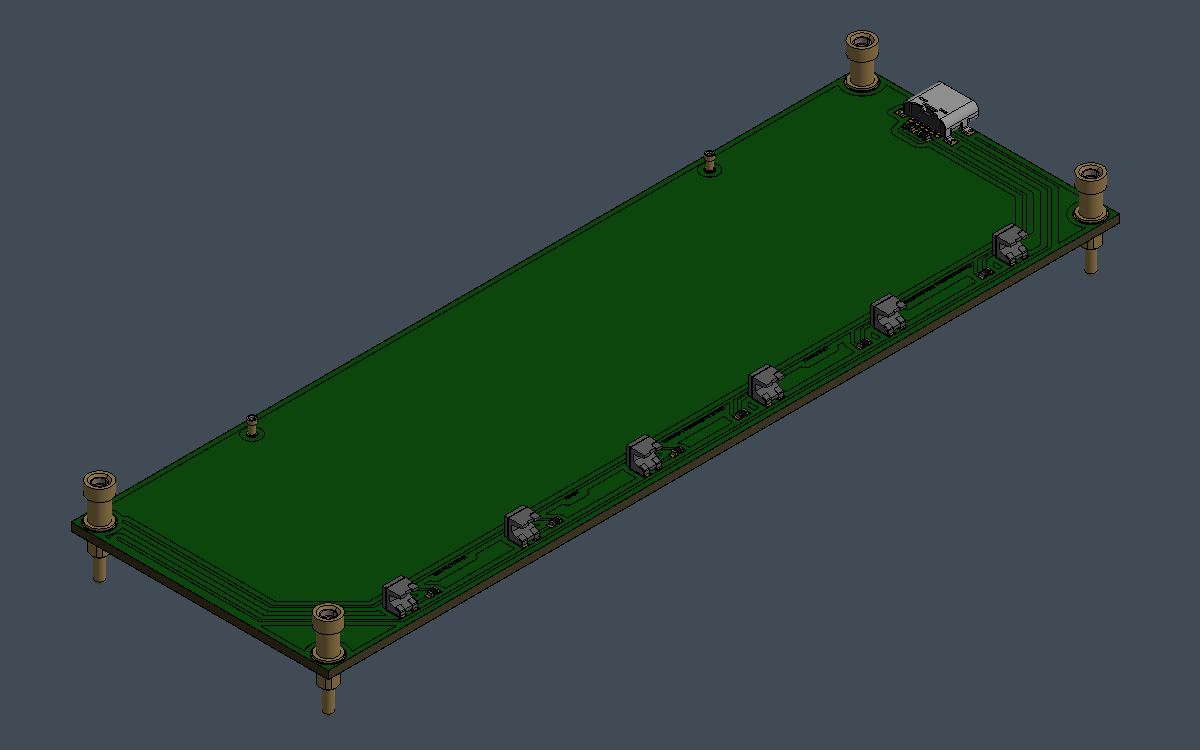
Bill of materials (from rev3/fusion/nametag-blank-large-led-bom.csv and Adonis's page):
| Ref | Qty | Part | Notes |
|---|---|---|---|
| LED1 to LED6 | 6 | ams OSRAM LW A6SG-V2BA-FK0PN0, white SIDELED | part page |
| R3 to R7, R9 | 6 | 100 ohm 0603, Royalohm CQ03WAF1000T5E | Adom Basic Part |
| R1, R2 | 2 | 5.1 kohm 0603, Royalohm 0603WAF5101T5E | USB-C CC pulldowns |
| J2 | 1 | GCT USB4135-GF-A, power-only USB-C | part page |
| MP1 to MP4 | 4 | Adom machine pin, Large Standard | workcell fixturing |
2. Finding where the name can go
Nameplate Generator reads the board's EAGLE source (rev3/fusion/nametag-blank-large-led.brd),
rasterises every top-side feature (copper, pads, silkscreen, part outlines, the machine-pin
heads), grows each by a 1.2 mm clearance, and finds the largest clear rectangle. On this
revision that is 120 x 32 mm at the board centre. Side-firing LED bodies reach 4.3 mm below their
pads, further than their footprint outline says, so the generator carries those bodies as extra
keep-outs read off the 3D model.
3. Laying out the name
The generator sets the name as one native text object in a production-tested ComMarker Studio
.orzr template. Only the text, font, size and letter width change. Pen, power, speed,
frequency, fill and the document's pen table are copied byte for byte from the template, so a
laser setting is never invented per job. A new design starts as large as the name area allows:
the letter width is solved between 50 and 200 percent so the name fills the area both ways.
4. The 3D model of the finished plate
rev3/plate/make-plate.py rebuilds the plate as a 3D model so it can be inspected on this page:
it draws the artwork into a transparent texture the size of the board outline (24 px per mm),
then adds one textured quad 10 um above the soldermask of Adonis's blank GLB, leaving every
original mesh untouched. Layout measured from the finished plate: the name is 118 mm wide,
centred 27.5 mm above the bottom edge, capped at a 13 mm cap height; the logo is 34 mm wide,
centred 10.5 mm up. The logo is Astera's own, from astera.org, rasterized with resvg. The
typeface is Liberation Sans Bold, the closest open face to the plate's; the plate itself is set
by the Nameplate Generator.
python3 rev3/plate/make-plate.py rev3/fusion/nametag-blank-large-led.glb steven-moss-plate.glb \
        steven-moss-etch-artwork.png "Steven Moss" astera-logo.png
5. Ablating it
The job runs on the UV fiber laser in Adom's workcell, which removes silkscreen and soldermask in
the shape of the letters. The blank is located by its four machine pins, so every plate lands in
the same place. The generator can queue the job straight to the laser (nameplate queue) with its
metadata: name, font, size, pen, board, template and file hashes, and who asked.
Results
- The blank boards are fabricated and assembled.
- Steven's plate is finished: "Steven Moss" on the first line and the Astera logo on the second, ablated into the soldermask, lit from the edge by the six side LEDs. The 3D model at the top of this write-up reproduces its layout, and the photo above is the plate itself.
Known limits
- Machine pin fit. The blank drills 3.6 mm for the large machine pin, a line-to-line fit rather than the documented 0.15 mm press fit, so the pins are soldered, not pressed. (Recorded on Adonis's page.)
- One layout per name, checked by a person. The generator guarantees the name fits; it cannot know a name is spelled right. Check it against a primary source, such as the person's own email signature, before the job runs.
Reproduce this experiment
Tools
| Tool | Version | What it did | Get it |
|---|---|---|---|
| Fusion 360 Electronics | Fusion v40 | Board and schematic design | autodesk.com |
| Nameplate Generator | 0.1.19 | Name area, layout, .orzr export, laser queue |
adom-wiki pkg install adom/nameplate-generator |
| ComMarker Studio | laser PC | Runs the .orzr job |
ships with the ComMarker laser |
| Adom workcell, UV fiber laser | Ablation | Adom Industries, Fort Worth |
Steps
The blank board. Open rev3/fusion/nametag-blank-large-led.fbrd and .fsch in Fusion 360
Electronics, or the EAGLE .brd and .sch in EAGLE or KiCad (KiCad imports EAGLE). Send the
board to fabrication with nametag-blank-large-led-bom.csv and -cpl.csv for assembly. The full
Fusion archive (.f3d, 39 MB), the STEP and a USDZ are on
Adonis's page.
The name.
adom-wiki pkg install adom/nameplate-generator
nameplate start                      # serves the dashboard on port 8960
nameplate open                       # shows it in a Hydrogen webview
nameplate name "Steven Moss"
nameplate maximize                   # as large as the name area allows
nameplate shot                       # screenshot, to check it before exporting
nameplate export --out ./jobs        # writes nameplate-steven-moss.orzr
nameplate queue                      # or send it straight to the workcell's laser queue
Fixture the blank on the workcell by its four machine pins and run the job.
Outputs
| File | What it is | License |
|---|---|---|
rev3/fusion/nametag-blank-large-led.fbrd, .fsch |
Fusion native board and schematic | see note |
rev3/fusion/nametag-blank-large-led.brd, .sch |
EAGLE board and schematic | see note |
rev3/fusion/nametag-blank-large-led-bom.csv, -cpl.csv |
BOM and pick-and-place | see note |
rev3/fusion/nametag-blank-large-led.glb |
3D model, Z-up, anchored at MP1 | see note |
rev3/photos/blank-board-render-*.png |
Renders of the blank, from Adonis's page | see note |
rev3/photos/steven-moss-plate-thumb.jpg, steven-moss-plate-in-workcell.jpg |
Photos of the finished plate (Kale Weimer, Adom) | CC BY 4.0 |
rev3/plate/steven-moss-plate.glb |
3D model of the finished plate (blank plus artwork); also the page's 3D Model | CC0 (artwork layer) |
rev3/plate/steven-moss-etch-artwork.png |
The artwork texture | CC BY 4.0; the Astera logo remains Astera's |
rev3/plate/make-plate.py |
Builds the plate model from any name and logo | MIT |
| this document | Method and results | CC BY 4.0 |
License note. The board files and renders are Adonis Lysandrou's, copied unmodified from his page, which does not declare a license yet. Until it does they are shared for reference under Adom Industries' copyright. Declaring one (MIT, matching Revs 1 and 2) is an open item.
Provenance
| Board design | Adonis Lysandrou (Fusion 360 Electronics, rev 21 Sep 2026, Fusion v40) |
| Name layout and ablation | Adonis Lysandrou |
| Photos of the finished plate | Kale Weimer |
| Laser job generator | Nameplate Generator 0.1.19, Aditya Angajala |
| Plate 3D model | Claude Opus 5.5, make-plate.py, from the blank GLB and astera.org's logo |
| Write-up | Claude Opus 5.5 (Anthropic), from the board's published files and the generator's documentation |
Contributor roles (CRediT): Adonis Lysandrou, investigation, resources, methodology. Kale Weimer, visualization. Aditya Angajala, software. John Lauer, supervision. Claude (AI), writing.
Funding
The node is funded by the U.S. National Science Foundation PCL Test Bed program (ROR 021nxhr62). Made for the Astera Institute (ROR 00ydx1s47); Astera did not fund it.