app
KiCad - the KiCad Bridge
Public Made by Adomby adom
Reference implementation of the KiCad bridge — multi-instance Python server, forward path via kicad-cli, reverse path via in-process plugin. Most complex of the three bundled bridges.
123456789101112131415161718192021222324252627282930313233343536373839404142434445464748495051525354555657585960616263646566676869707172737475767778798081828384858687888990919293949596979899100101102103104105106107108109110111112113114115116117118119120121122123124125126127128129130131132133134135136137138139140141142143144145146147
{
"schema_version": 1,
"type": "app",
"slug": "kicad-bridge",
"title": "KiCad - the KiCad Bridge",
"brief": "Reference implementation of the KiCad bridge — multi-instance Python server, forward path via kicad-cli, reverse path via in-process plugin. Most complex of the three bundled bridges.",
"version": "1.0.25",
"tags": [
"kicad",
"pcb",
"schematic",
"eda",
"bridge",
"ab",
"adom-bridge",
"desktop-app"
],
"license": "MIT",
"discovery_triggers": [
"kicad bridge",
"open my pcb",
"open my pcb design",
"open my board in kicad",
"open my schematic",
"open my circuit board",
"design a circuit board",
"edit my pcb",
"edit my schematic",
"open a kicad board",
"open a kicad project",
"run drc",
"run drc on my board",
"run erc on my schematic",
"check my board for errors",
"export gerbers",
"export gerber files",
"export gerbers for jlcpcb",
"make gerbers for my pcb",
"export a step file from my board",
"export bom",
"export a bom from my schematic",
"show my board in 3d",
"open the 3d viewer",
"view my pcb in 3d",
"open kicad",
"launch kicad",
"install kicad",
"upgrade kicad",
"is kicad installed",
"what kicad versions do i have",
"install a kicad symbol",
"install a footprint in kicad",
"add a library to kicad",
"open the symbol editor",
"open the footprint editor",
"screenshot kicad",
"take a screenshot of my board",
"place a footprint",
"open a kicad_pcb file",
"open a kicad_sch file"
],
"discovery_pitch": "Drive KiCad on the user's desktop: open boards/schematics/symbols/footprints, run DRC/ERC, export gerbers/STEP/BOM, view in 3D. First run `adom-bridge-cli bridge_list` to confirm the kicad bridge is installed; if so, drive its `kicad_*` verbs (kicad_describe lists them, kicad_readiness checks KiCad is present). If this container lacks the skill, run `adom-wiki pkg install adom/kicad-bridge` or `adom-bridge-cli sync_skills`.",
"sample_prompts": [
{
"label": "Read kicad bridge source",
"prompt": "Download the kicad-bridge zip from the wiki and walk me through its server.py"
},
{
"label": "Add a new kicad verb",
"prompt": "Help me add a new kicad_get_layer_image verb to the in-process bridge plugin"
},
{
"label": "Understand reverse bridge",
"prompt": "Explain how kicad_bridge_call routes from cloud Docker into the running pcbnew.exe"
},
{
"label": "List kicad verbs",
"prompt": "adom-bridge-cli bridge_list and show me the kicad verbs"
},
{
"label": "Try the watcher pip",
"prompt": "Enable project watch in Adom Bridge settings for a kicad project"
}
],
"install": {
"binary_name": "adom-desktop-kicad-bridge",
"install_dir": "",
"install_hint": "",
"version_cmd": ""
},
"readme": "# Adom Desktop — KiCad Bridge\n\nA **reverse bridge** that lets Adom Desktop (AD) — and the AI driving it — control the user's own\nKiCad on Windows: open and drive every editor, install symbol/footprint libraries, place parts, run\nDRC/ERC, export manufacturing files, and screenshot any window back to the AI.\n\nKiCad is the user's **host app**. The bridge *detects* an existing KiCad and, if none is present,\n*installs* one for them — it never asks the user to download or click through anything by hand.\n\n- **Page / docs:** https://wiki.adom.inc/adom/adom-desktop-kicad-bridge\n- **Bridge SDK:** https://wiki.adom.inc/adom/adom-desktop-bridges\n- **Verb namespace:** `kicad_*` · **Status verb:** `kicad_bridge_status` · **Health:** `GET /status`\n\n> Every screenshot in this README was captured on **ADOMBASELINE**, a stock Hyper-V VM with **no\n> GPU**, driven end-to-end through the bridge — install → libraries → editors → 2D → 3D. If it\n> renders there, it renders on a real laptop.\n\n---\n\n## Demo — narrated live editor tour (real screen recording)\n\n[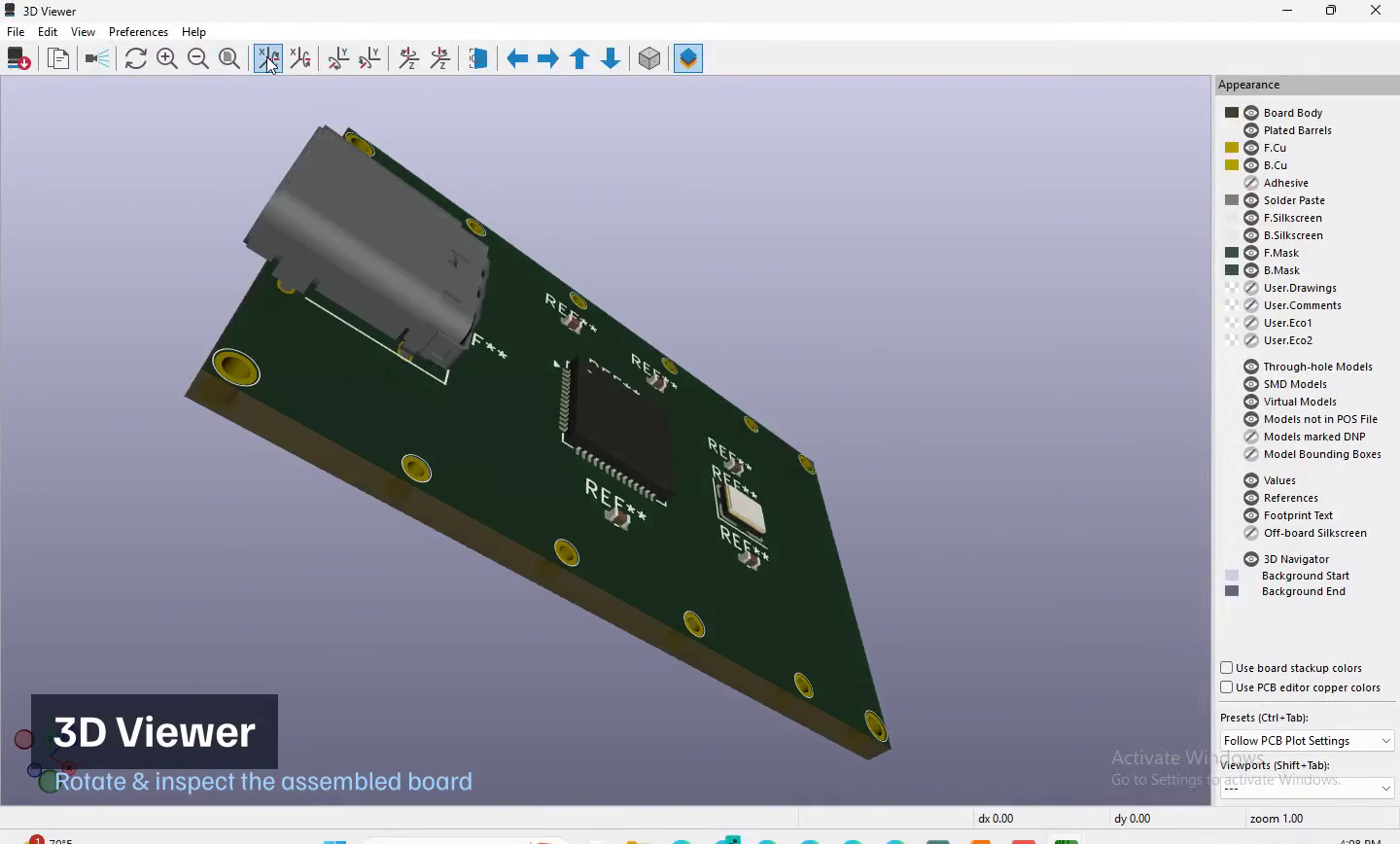](https://wiki.adom.inc/blob/app/adom-desktop-kicad-bridge/kicad-bridge-demo.mp4)\n\n**▶ [Watch the demo](https://wiki.adom.inc/blob/app/adom-desktop-kicad-bridge/kicad-bridge-demo.mp4)** (48s, 🔊 narrated) — the bridge driving real KiCad on a Windows VM: **select** a footprint and **zoom** the copper in the PCB editor, **rotate** the assembled board in 3D, then tour the schematic, symbol, and footprint editors. Genuine screen recording of the live windows (zoom / select / 3D rotation), narrated section by section — not animated stills.\n\n\n---\n\n## The demo verb — `kicad_demo`\n\nOne verb that shows the whole bridge off, built for the AI that demos Adom Desktop\nduring Hydrogen Desktop's install. Six beats, in the order a hardware person thinks:\n\n| Beat | Shows |\n|---|---|\n| 1 | the **schematic symbol** in the user's own Symbol Editor |\n| 2 | the **footprint** for that same part |\n| 3 | that part in **3D** |\n| 4 | a **schematic** using it (U1 + two 10k resistors) |\n| 5 | the **2D board layout** |\n| 6 | the finished **board in 3D** |\n\n```bash\nadom-desktop kicad_demo '{}' # start: prepares, warms KiCad, opens beat 1\nadom-desktop kicad_demo '{\"step\":\"footprint\"}' # ...then follow data.nextCall each time\nadom-desktop kicad_demo '{\"all\":true}' # bulk (non-interactive; slower than one request budget)\nadom-desktop kicad_close '{\"force\":true}' # tear down\n```\n\n**It narrates itself.** Every beat returns `say` (a line to speak), `pointOut`\n(what's actually on screen), `window` (match it in `kicad_screenshot_all`) and\n`nextCall`. One beat per call is the default precisely so the AI can talk, screenshot,\nthen move on.\n\n**It ships nothing.** The two demo parts, the schematic and the board are all\ngenerated in code, and the 3D bodies come from KiCad's *own* bundled\n`3dmodels/*.3dshapes` — so the runtime zip stays small and the 3D views are real.\nParts install into the user's real `Adom` library; the project lands in\n`Documents/adom-kicad-demo`.\n\n**No KiCad? It offers to install it.** `kicad_demo` returns an offer instead of an\nerror; `kicad_demo '{\"installKiCad\": true}'` silently installs the official build\n(per-user, no UAC) and then runs the tour. Watching the AI install your EDA tool is\nitself a good demo beat.\n\n**It never takes your screen.** Every window opens in the background and all input is\nwindow-targeted (UIA / `PostMessage`), so you can keep working while it runs.\n\n---\n\n## How it fits together\n\nThe bridge is a `spawn.kind: python` process AD launches on the user's machine (`entrypoint:\nserver.py`, `port: 0` — AD picks the port and passes `ADOM_BIND_HOST`). It speaks HTTP\n(`POST /command`, `GET /status`) and reaches KiCad through **four control surfaces**, picking the\nlightest one that can do the job.\n\n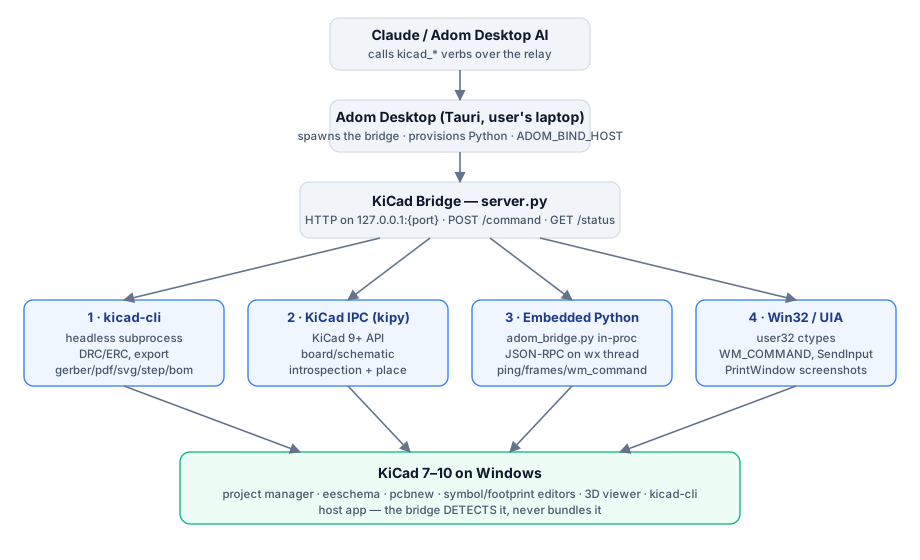\n\n| # | Surface | Used for | Where |\n|---|---------|----------|-------|\n| 1 | **kicad-cli** (subprocess) | headless DRC/ERC, gerber/pdf/svg/step/bom export, format upgrade | `handlers/export.py`, `run_drc`, `run_erc`, `lint_*` |\n| 2 | **KiCad IPC (kipy)** | board/schematic introspection, confirmed footprint placement (KiCad 9+) | `handlers/place_footprint.py` |\n| 3 | **Embedded Python** | JSON-RPC *inside* each KiCad process, dispatched on its wx UI thread | `plugin_payload/adom_bridge.py`, `handlers/bridge_client.py` |\n| 4 | **Win32 / UIA / SendKeys** | open editors, screenshots, clicks/keys, dialog handling, window management | `handlers/kicad_ui.py`, `handlers/close_windows.py` |\n\n---\n\n## The window tour\n\nEverything below was opened and captured on the GPU-less VM. Sample data is the **RP2040 breakout**\ngenerated by `tour-pack-rp2040/` (an `AdomRP2040` symbol + `QFN-56_AdomRP2040` footprint + a board).\n\n### Schematic editor — `kicad_open_schematic`\n\nThe RP2040 breakout: the MCU (U1), USB-C, a 12 MHz crystal, decoupling, and mounting pins.\n\n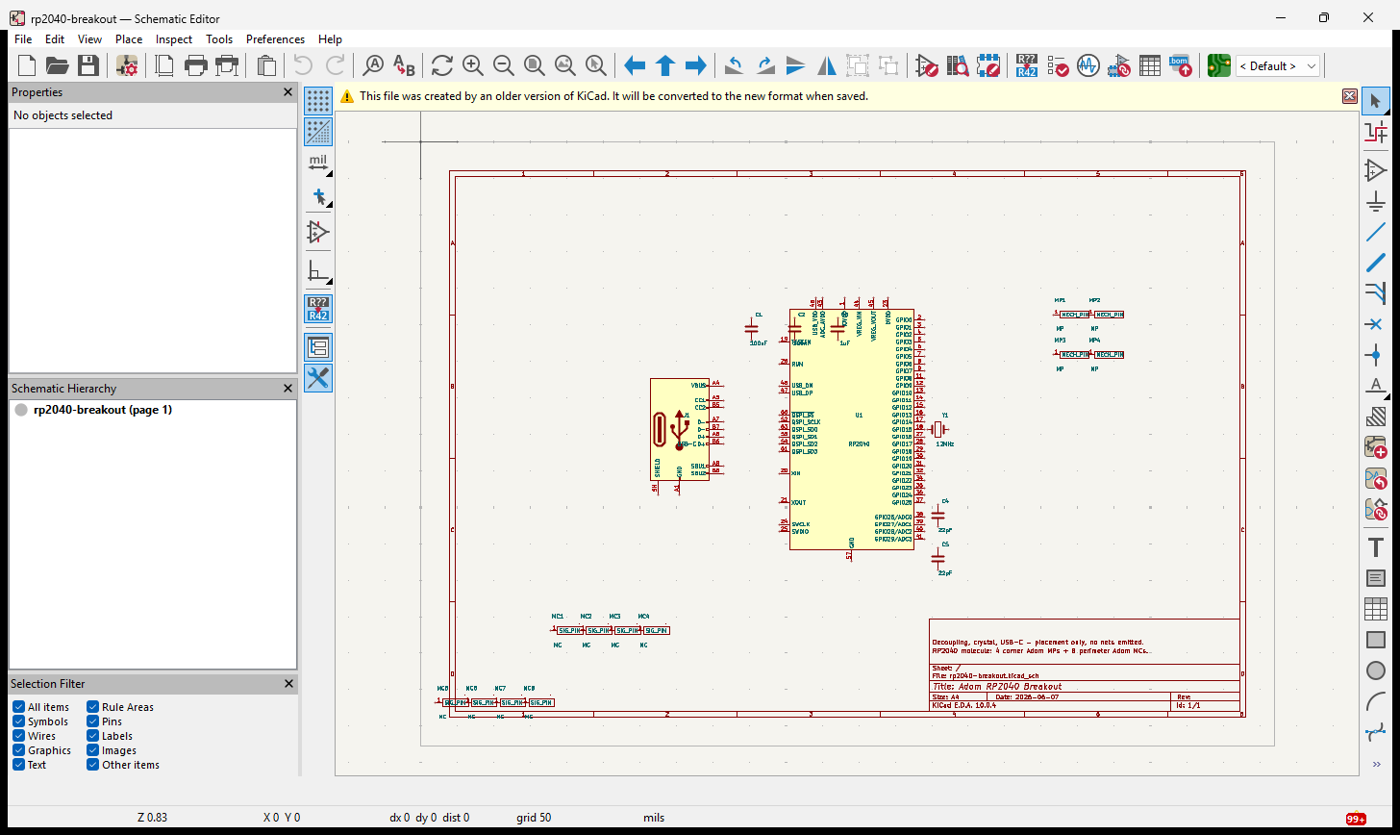\n\n### Symbol editor — `kicad_open_symbol_editor`\n\nOpens straight to a symbol (`kicad_install_symbol` puts it in a user library first).\n\n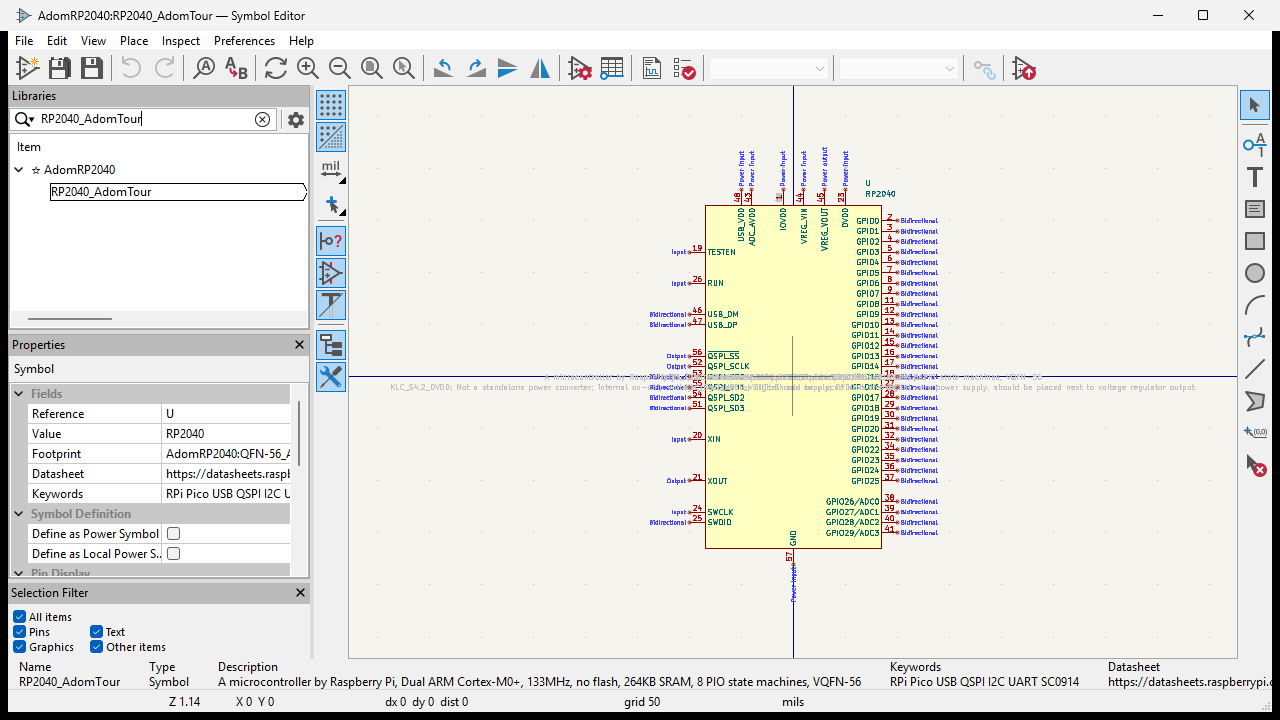\n\n### Footprint editor — `kicad_open_footprint_editor`\n\n`{\"footprintName\":\"QFN-56_AdomRP2040\",\"library\":\"AdomRP2040\"}` loads the part directly — 56 pins +\nthermal pad, 7×7 mm, 0.4 mm pitch, courtyard and silkscreen.\n\n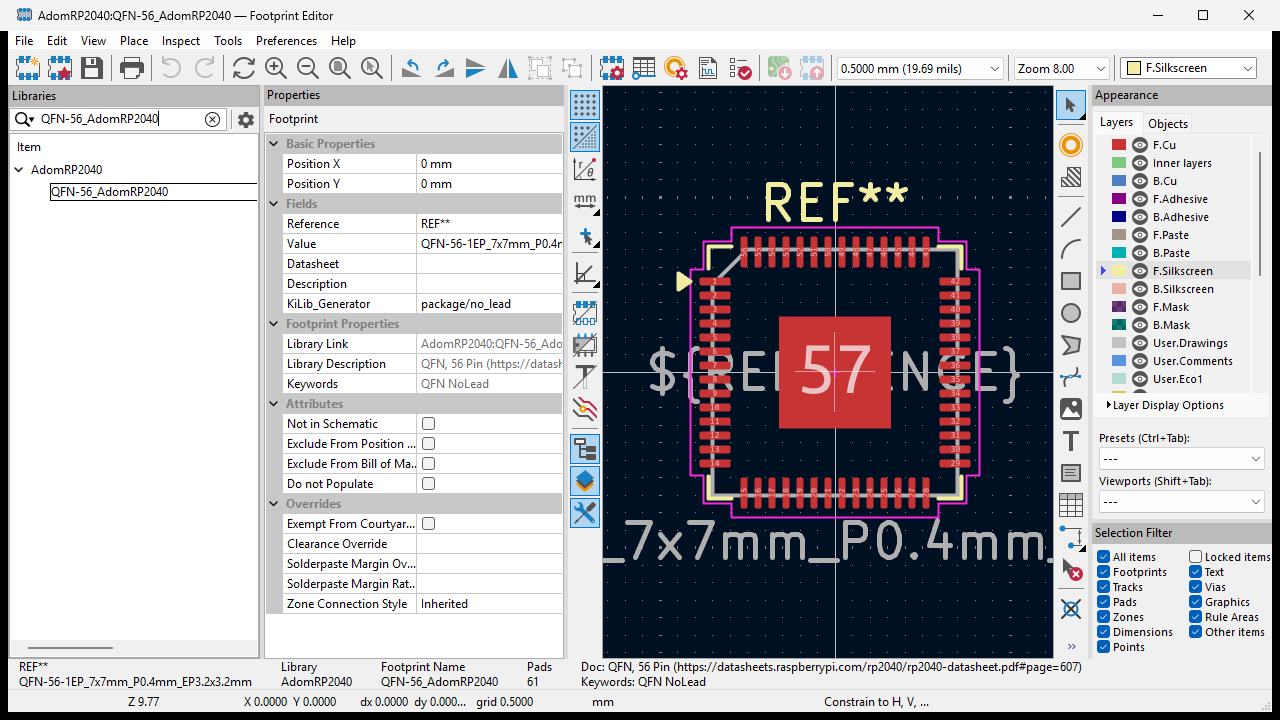\n\n### PCB editor (2D) — `kicad_open_board`\n\nThe routed breakout — copper, silkscreen, the QFN-56 land pattern, mounting holes.\n\n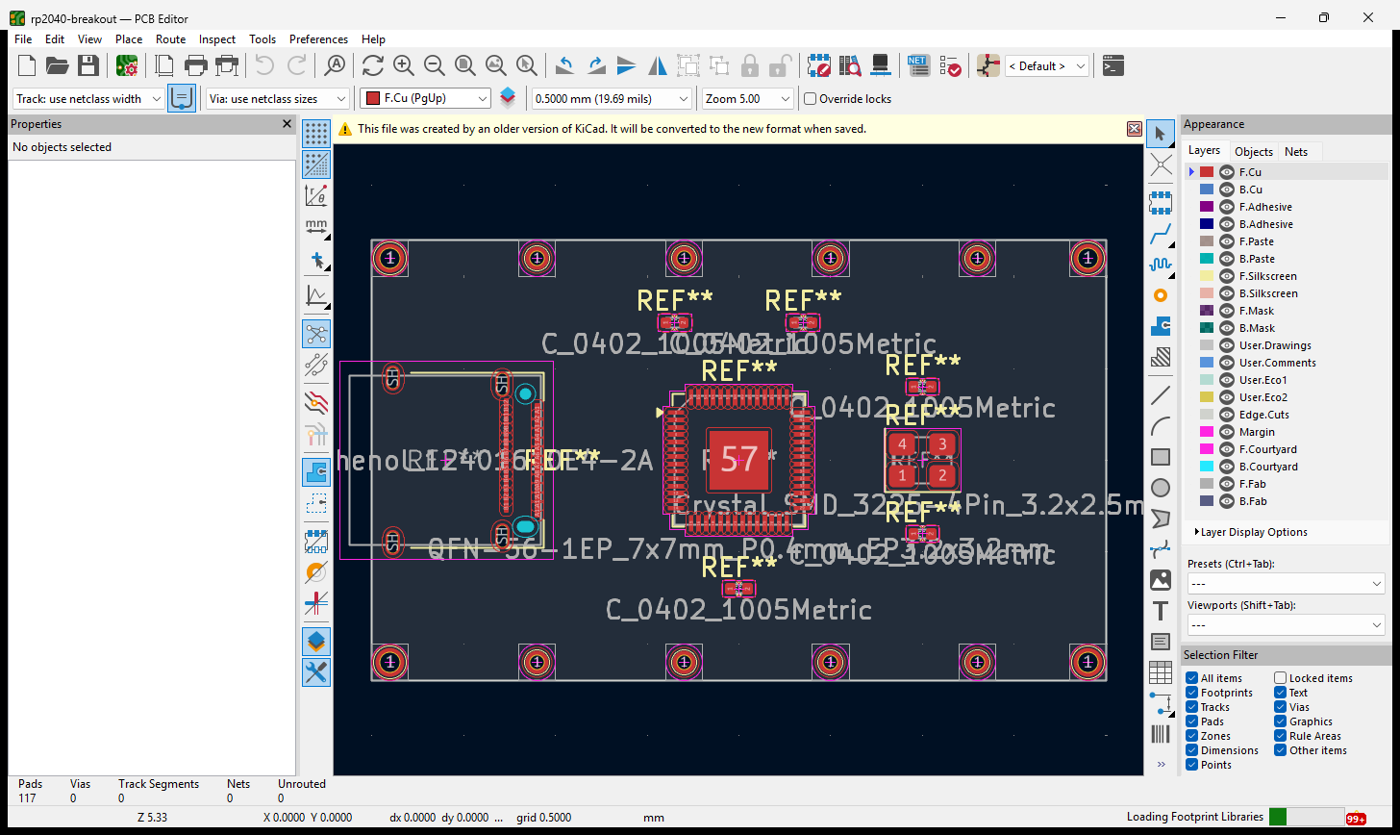\n\n### 3D viewer — `kicad_open_3d_viewer {\"editor\":\"pcb\"}`\n\nThe full board in 3D — board body, the USB-C connector's 3D model, the QFN chip body, SMD parts,\nplated through-holes. **Rendered on the CPU via the software-OpenGL fallback (below); reload 1.7 s.**\n\n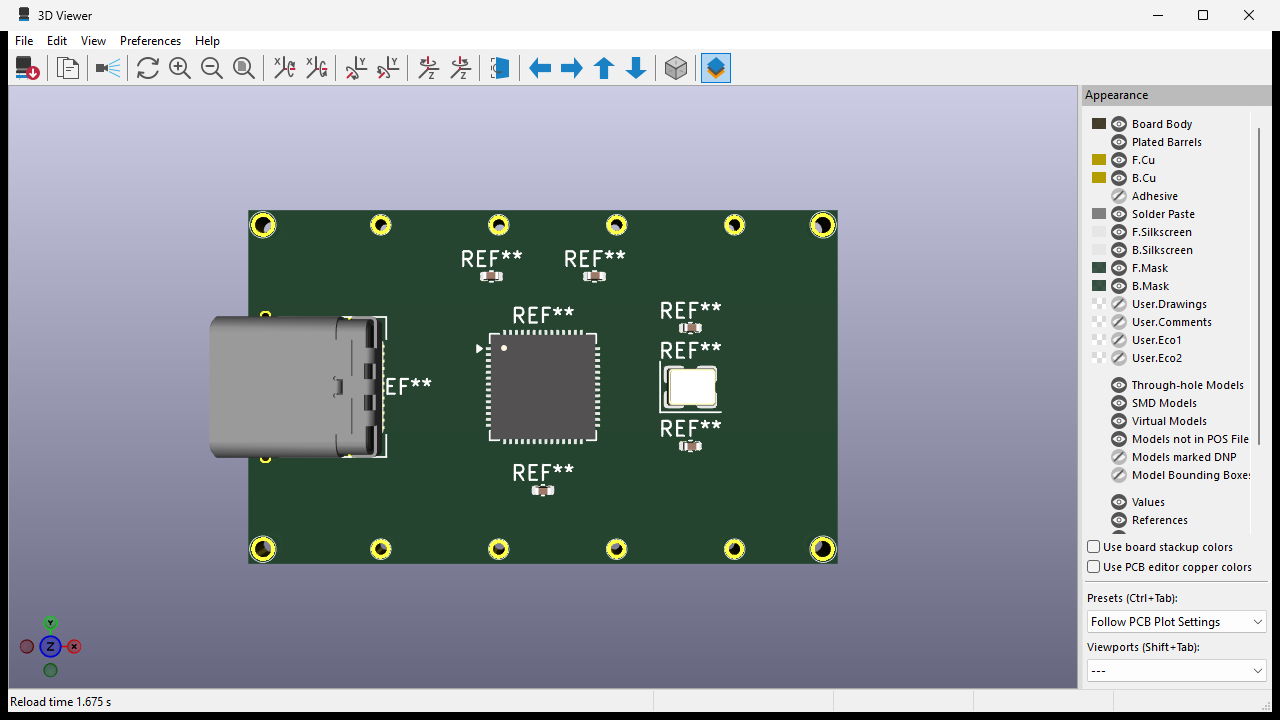\n\n---\n\n## Install & upgrade — zero manual steps\n\nThe bridge never tells the user to go download KiCad. `kicad_upgrade` fetches the official installer\nand runs it silently, picking the scope automatically:\n\n- **Elevated AD** → `/allusers /S` (system-wide, `%ProgramFiles%\\KiCad`).\n- **Non-elevated AD** → `/currentuser /S` (`%LocalAppData%\\Programs\\KiCad`, **no UAC prompt**).\n\n`kicad_readiness` reports whether KiCad is installed and ready without side effects; the AI routes on\nit before offering to install. Hard-won install details (all handled for you):\n\n- KiCad 10's NsisMultiUser installer **requires** a scope flag — bare `/S` errors `rc=666660`.\n- AD's portable Python has **no CA bundle**; the bridge ships `certs/cacert.pem` and uses it for TLS.\n- Downloads are size-checked against `Content-Length` (a truncated installer otherwise fails at NSIS).\n- `%APPDATA%/kicad/<ver>/` lib tables don't exist until first launch — the bridge **bootstraps** them\n so `install_library`/`install_footprint` work on a never-opened KiCad.\n- `kicad_upgrade {\"diagnoseOnly\":true}` reports token-elevation type + `EnableLUA` without installing.\n\n---\n\n## Dialogs & error handling — the bridge clears the pointless ones\n\nKiCad throws modal dialogs that stall automation. The bridge **scans every window owned by a running\nKiCad process** (by PID — reliable, unlike title matching), auto-expires the benign ones, screenshots\nwhat it dismissed, and returns a hint so the AI can decide what (if anything) to tell the user.\n\nAuto-expired benign dialogs include:\n\n- **\"Could not use OpenGL / falling back to software rendering\"** (GPU-less hosts).\n- **\"Welcome to KiCad — starting for the first time\"** first-run wizard (dismissing accepts defaults).\n- **\"This file was created by an older version of KiCad\"** conversion notice.\n\n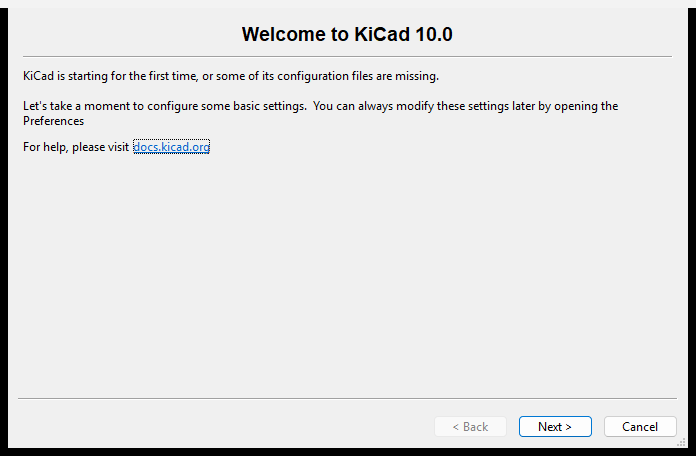\n\nVerbs:\n\n- `kicad_window_info` — lists windows and **self-heals** (auto-expires benign dialogs) by default.\n- `kicad_dismiss_dialogs {\"all\":true}` — clear everything blocking; `{\"screenshot\":true}` returns\n images of each; `{\"forceSoftwareCanvas\":true}` persists Cairo canvas; `{\"debug\":true}` dumps the\n raw PID-based scan.\n- `kicad_screenshot_all` — one call returns **every** open KiCad window, so the AI can spot an error\n dialog it didn't expect and read the message.\n\n---\n\n## Software-OpenGL fallback (last resort)\n\n`kicad_enable_software_opengl` deploys Mesa's `llvmpipe` (a CPU OpenGL rasterizer) into KiCad's `bin`\nso a box with **no usable GPU** — Hyper-V, RDP, headless CI — can still render the editors and the 3D\nviewer. This is how every 3D shot above exists.\n\n> ⚠️ It renders on the CPU and is **slow**. It is a worst-case fallback only — a real GPU (or GPU-P /\n> DDA passthrough) is vastly better. The bridge keeps it so a GPU-less box isn't a dead end; it is\n> never suggested proactively.\n\n---\n\n## Verb reference\n\nAll 41 verbs (prefix `kicad_`). Call `kicad_describe` for the live catalog with per-verb hints,\nrelated verbs, and pitfalls.\n\n**Windows & UI** — `open_board`, `open_schematic`, `open_symbol_editor`, `open_footprint_editor`,\n`open_3d_viewer`, `open_editors`, `close_symbol_editor`, `close_footprint_editor`, `close_3d_viewer`,\n`close`, `window_info`, `dismiss_dialogs`, `screenshot_all`, `send_key`, `click`, `fix_keyboard`\n\n**Libraries & parts** — `install_library`, `install_symbol`, `install_footprint`, `install_plugin`,\n`place_footprint`, `adom_library_status`\n\n**Checks & export** — `run_drc`, `run_erc`, `lint_board`, `lint_schematic`, `lint_library`,\n`format_upgrade`, `export_gerber`, `export_pdf`, `export_svg`, `export_step`, `export_bom_csv`\n\n**Detect, install & meta** — `list_versions`, `readiness`, `describe`, `enable_software_opengl`,\n`check_for_updates`, `upgrade`, `bridge_status`, `bridge_call`\n\n---\n\n## Running / dependencies\n\nAD provisions everything; there is nothing to install by hand.\n\n- **Python** ≥ 3.11 (AD provisions it) — stdlib only, plus the bundled `certs/cacert.pem`.\n- **KiCad** ≥ 7.0 (host app; `kicad_upgrade` installs it if absent).\n- **OS:** Windows (macOS/Linux detection stubs exist; the GUI surfaces are Windows-first).\n\nThe bridge binds `ADOM_BIND_HOST` on an AD-assigned port — never `0.0.0.0`. Auto-updates via\n`updateManifestUrl` in `bridge.json`.\n\n---\n\n*Developer & publish notes live in `dev-skills/` and `publish-skills/` (source-only, never shipped to\na user install).*\n",
"author": {
"name": "Kyle Bergstedt",
"email": "[email protected]"
},
"visibility": "public",
"hero": {
"type": "image",
"path": "screenshots/hero.png"
},
"metadata": {
"binary_name": "adom-bridge-kicad"
},
"created_at": "2026-05-28T05:28:43.294Z",
"updated_at": "2026-08-09T13:54:41.337Z",
"skills": [],
"author_name": "John Lauer",
"source_visibility": "public",
"description": "Skills for your container so your AI knows how to drive the KiCad bridge. The bridge runtime itself is the release zip; Adom Bridge loads that.",
"dependencies": {
"adom/adom-bridge": "^2.0.3"
},
"scripts": {
"install": "./install.sh",
"uninstall": "./uninstall.sh"
},
"files": [
"README.md",
"SKILL.md",
"package.json",
"install.sh",
"uninstall.sh",
"skills/kicad-interaction/SKILL.md",
"skills/kicad-3d-models/SKILL.md",
"skills/kicad-tour/SKILL.md",
"skills/kicad-tour/tour_runner.py",
"skills/kicad-bridge-dev/SKILL.md",
"skills/kicad-bridge-publish/SKILL.md",
"skills/kicad-bridge-hero/SKILL.md",
"skills/kicad-bridge-hero/compose_hero.py"
],
"org": "adom",
"name": "kicad-bridge",
"keywords": [
"kicad",
"pcb",
"schematic",
"eda",
"bridge",
"ab",
"adom-bridge"
],
"binary_name": "adom-bridge-kicad",
"authors": null,
"author_handle": "john",
"authors_json": "[\"john\"]"
}