adom-plan — Exhaustive Plan Review
Public Made by Adomby adom
Expand a sketch into a full plan, then stress-test it with 6+ adversarial debate agents (Opus vs Sonnet pairs) plus a red-team consensus attack and a scored synthesis.
| Name | Last updated |
|---|---|
| screenshots | 3mo ago |
| debate-prompts.md | 3mo ago |
| install.sh | 3mo ago |
| package.json | 3mo ago |
| page.json | 3mo ago |
| README.md | 3mo ago |
| SKILL.md | 3mo ago |
| uninstall.sh | 4mo ago |
adom-plan — Exhaustive Plan Review
End-to-end planning pipeline: expand a sketch into a detailed plan, then stress-test it via adversarial multi-model debate. Runs a built-in Opus expansion pass to flesh out the sketch, then launches three adversarial pairs (6 agents: Opus vs Sonnet per category) arguing architecture, implementation, and security from opposite dispositions. A 7th agent red-teams the consensus. Final output is a scored, vetted plan with validation strategies, E2E testing, a risk register, and prioritized action items.
Total agents: up to 8 (1 expansion + 6 debate + 1 red-team consensus).
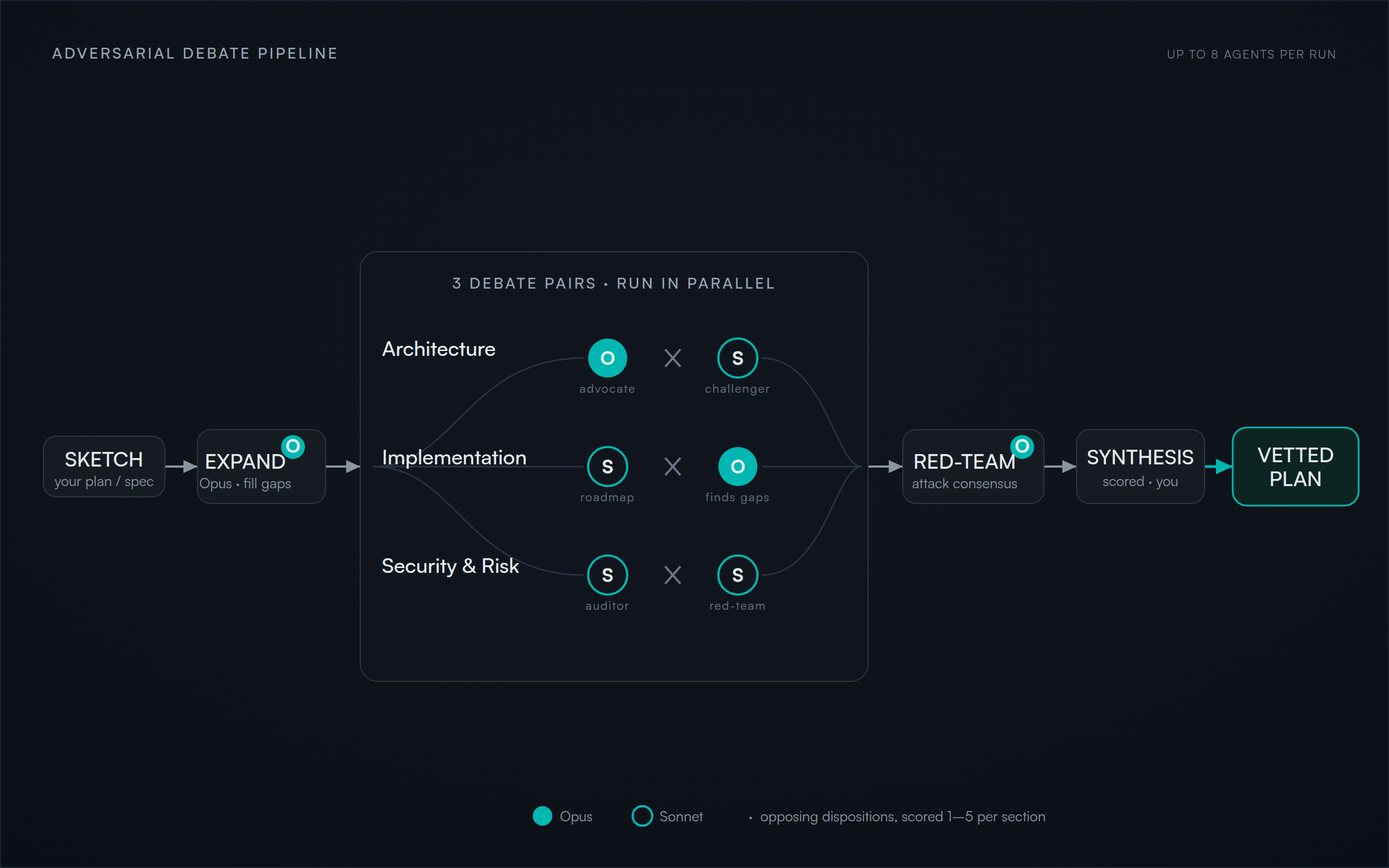
How it works
- Phase 0 — Locate the plan (plan file, file path argument, or conversation context)
- Phase 0.5 — Expand the plan via a built-in Opus expansion agent
- Phase 1 — Fetch platform context via the
adom-wikiCLI (wiki catalog, installed skills, recent wiki activity, existing plans) - Phase 2 — Launch 6 adversarial debate agents in parallel (3 pairs):
- Architecture: Opus advocate vs Sonnet challenger
- Implementation: Sonnet roadmap-builder vs Opus gap-finder
- Security & Risk: Sonnet auditor vs Sonnet red-team attacker
- Phase 3 — Red-team the consensus with one final Opus agent
- Phase 4 — Scored synthesis: scorecard, contested decisions, risk register, E2E strategy, action items
- Phase 5 — Present the summary to the user
Key features
- Adversarial pairing — two agents argue each category from opposite dispositions, surfacing disagreements a single model would self-censor
- Multi-model diversity — Opus reasons conservatively and architecturally; Sonnet is pragmatic and detail-oriented
- Structured scoring — 1–5 scale across Feasibility, Maintainability, Platform Leverage, Simplicity; 2+ point deltas auto-flagged
- Platform awareness — fetches the wiki catalog so agents reference real tools, not hypothetical ones
- The 30-Day Failure Scenario — forces concrete, actionable thinking about what will actually go wrong
- Consensus red-team — attacks the "safe" decisions everyone agrees on, because the most dangerous risks are the ones nobody flags
Then build it — pairs with three-musketeers
adom-plan is the plan half of Adom's complex-project pipeline. Once the plan is vetted here, build it with three-musketeers — the companion skill that drives the actual build through a Builder → Adversarial Reviewer → Verifier loop until it genuinely works:
- Plan robustly with adom-plan — 6+ vetting agents harden what to build.
- Build robustly with three-musketeers — 3 building agents harden that it was built and actually works (the Verifier confirms behavior as a user, not against the plan, so the builder is free to correct anything adom-plan got wrong).
Expensive but effective — reach for the full plan→build pipeline on high-stakes or long-running work.
Invocation
/adom-plan                          # review the active plan file
/adom-plan path/to/plan.md          # review a specific file
Output
The skill appends a Debate Review Summary to the plan file containing:
- Scorecard — per-section grades (A/B/C/F) with dimensional scores
- Consensus Decisions — verified safe items
- Contested Decisions — where agents disagreed, with recommendations
- Fragile Consensus — items the red-team flagged
- Risk Register — consolidated threat table with mitigations
- Validation & E2E Strategy — complete test plan
- The 30-Day Failure Scenario — the most likely production failure
- Action Items — numbered list tagged BLOCKING / RECOMMENDED / NICE-TO-HAVE