57e2489
Native bottom artwork — board23
Board23 adds 193 bottom text items and 92 graphic segments through the native KiCad API. It includes every component reference, paired passive values, physical contact functions, eleven contact/corner tags, nine association leaders, and the prototype title/date/wiki address. Seven bottom contact tags share the same width; TX/RX are from the load's perspective and 5V identifies the auxiliary supply. Reference/value groups use 1.0/0.8 mm text, with 0.9/0.8 mm corner tags and 0.8 mm IC references. Frame interruptions keep ink off holes, pads and text; retained outlines exceed 70 percent. No other part's pad is enclosed.
The complete candidate and the saved native result both pass project-aware DRC with zero violations and zero open connections. Saved readback verification checks every added text/line against the plan and preserves all electrical geometry. Eight pre-existing reference coordinates below 1e-12 mm merely serialize to zero. Native DRC · Native bottom render.
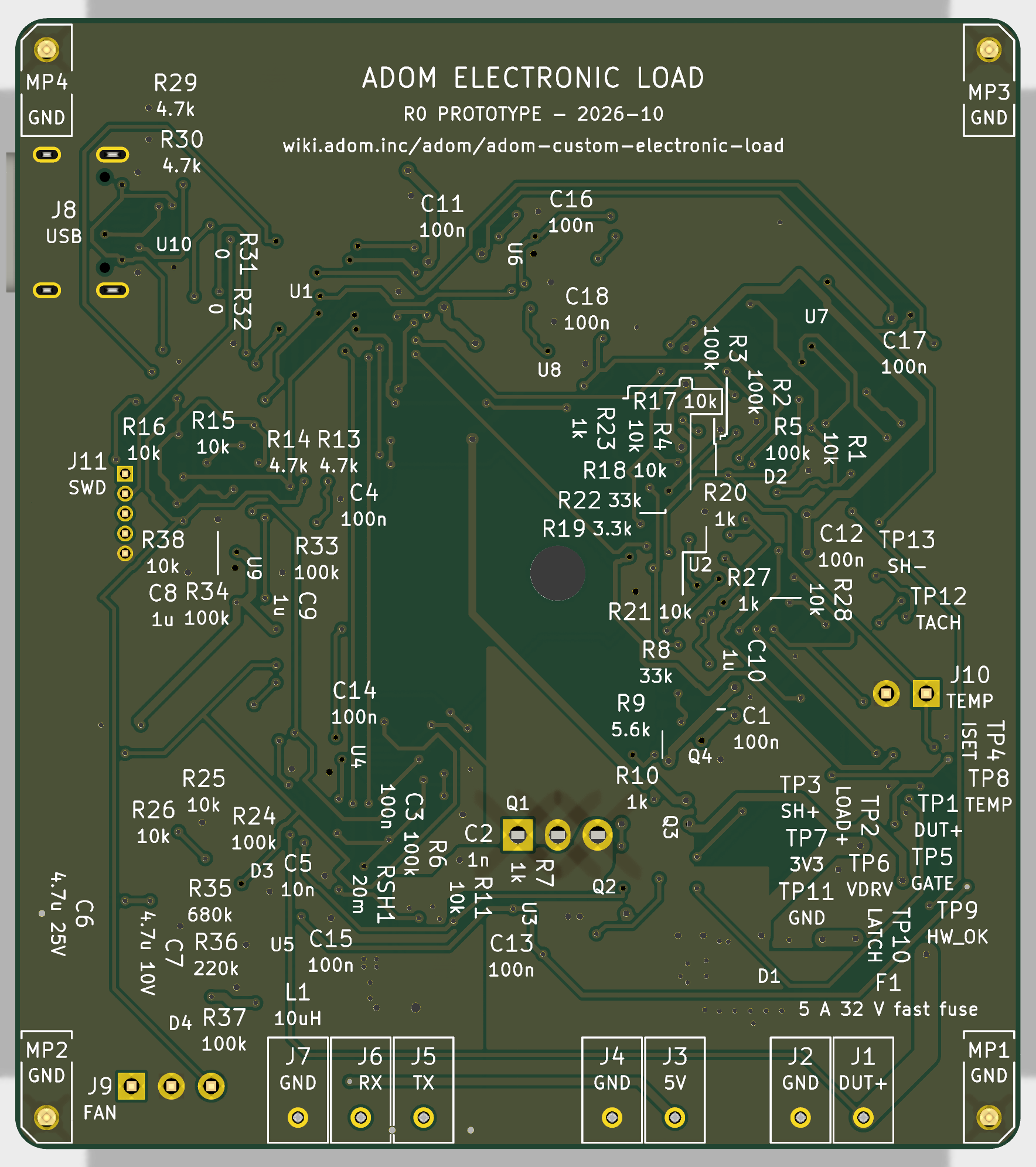
Watch the native labels and frames appear, 2×. This is an edited native inspection recording, not a smooth hero render. Its raw recorder timing warning is retained in the inventory; it is not wall-clock measurement evidence.
Current PCB SHA-256: 44678abfa0219151ce08165da98ae669f30fca88391411b0f66ecd91adc65189. Native revision: 25980cc31b2260d0b2fc8398099daf04610124dc10670d4dd0fa0f953b7f4d5c.
Full silkscreen acceptance remains open while front contact-function labels and fitted-cooling visibility are checked. Thermal and finished-copper dependencies remain open. Historical board22 evidence follows.
Native reference-label rework
AIFlow board 22 changes 48 reference-field positions or orientations. All other parsed board data is identical to v85, including pads, components, tracks, vias, zones, nets and rules. The candidate passed desktop KiCad 10.0.5 DRC with zero errors, warnings and open connections. Native top 3D and PCB views were inspected after reopening; R31/R32 clear the MCU pads, the test labels are separated, and R38 is vertical beside its resistor. This is an intermediate silkscreen improvement, not final board acceptance.
The original conservative screen measured 94 visible labels with KiCad's own text metrics. It found 49 obstacle-box intersections and one text-box pair; 46 obstacle intersections were via-hole reservations, and three involved exposed pads. These are bounding-box findings, not 49 proven printed-ink violations. The final local search placed every existing label without reducing its original text size.
The native field API accepted the complete candidate's DRC dry run but rejected its commit with native_field_update_unsupported on KiCad 10.0.5. The transaction rolled back and the live revision remained unchanged. The fallback saved and backed up the exact original, closed only its editor, changed the 48 property spans in a saved copy, checked native DRC with the actual project libraries/rules, then reopened the exact project. It was a saved-file edit, not a successful live field edit.
The generic service DRC attempt omitted the project context and reported default-rule copper-edge findings plus missing-library warnings. That report is retained for diagnosis and is not the acceptance report. The complete native desktop project check is silkscreen-candidate-drc.json.
Evidence: byte-preserving candidate comparison, native API dry run, refused API commit, and initial conservative screen.
Board SHA-256: 82c2fad50b3c2fb93b627df4a984bf7fe85724d73367e33e3d97206e0b752342. Reopened native revision: f9a4b7701329a2d162dcc584c0c176d7926b7d24f47dc484fae85319848b1f02.
Still incomplete: passive values, bottom identity, physical terminal/function labeling, complete artwork/leader audit and visibility with the cooling assembly fitted. A separate mirrored bottom reference/value proposal is being solved at the current project's minimum 0.8 mm text height; it is not on the board. Thermal and finished-copper dependencies remain open. Exact-board22 current screening passes at assumed 35 µm surface / 25 µm barrel copper; thermal screening still fails. Results are in design/silkscreen-review/fields-board22-0p1/fields.json.
The short candidate replay shows recorded solver events from an earlier pass with one unresolved label; it is explicitly labeled REPLAY. The native review shows the reopened board at 2×, without the cooling assembly. Neither is the final narrated film.
# Native bottom artwork — board23

Board23 adds 193 bottom text items and 92 graphic segments through the native KiCad API. It includes every component reference, paired passive values, physical contact functions, eleven contact/corner tags, nine association leaders, and the prototype title/date/wiki address. Seven bottom contact tags share the same width; TX/RX are from the load's perspective and 5V identifies the auxiliary supply. Reference/value groups use 1.0/0.8 mm text, with 0.9/0.8 mm corner tags and 0.8 mm IC references. Frame interruptions keep ink off holes, pads and text; retained outlines exceed 70 percent. No other part's pad is enclosed.

The complete candidate and the saved native result both pass project-aware DRC with zero violations and zero open connections. [Saved readback verification](../design/silkscreen-review/bottom-landing-verification.json) checks every added text/line against the plan and preserves all electrical geometry. Eight pre-existing reference coordinates below 1e-12 mm merely serialize to zero. [Native DRC](../design/silkscreen-review/bottom-landed-drc.json) · [Native bottom render](../design/silkscreen-review/bottom-candidate-bottom.png).

[Watch the native labels and frames appear, 2×](clips/bottom-silkscreen-native.mp4). This is an edited native inspection recording, not a smooth hero render. Its raw recorder timing warning is retained in the inventory; it is not wall-clock measurement evidence.

Current PCB SHA-256: `44678abfa0219151ce08165da98ae669f30fca88391411b0f66ecd91adc65189`. Native revision: `25980cc31b2260d0b2fc8398099daf04610124dc10670d4dd0fa0f953b7f4d5c`.

Full silkscreen acceptance remains open while front contact-function labels and fitted-cooling visibility are checked. Thermal and finished-copper dependencies remain open. Historical board22 evidence follows.

# Native reference-label rework

AIFlow board 22 changes 48 reference-field positions or orientations. All other parsed board data is identical to v85, including pads, components, tracks, vias, zones, nets and rules. The candidate passed desktop KiCad 10.0.5 DRC with zero errors, warnings and open connections. Native top 3D and PCB views were inspected after reopening; R31/R32 clear the MCU pads, the test labels are separated, and R38 is vertical beside its resistor. This is an intermediate silkscreen improvement, not final board acceptance.

The original conservative screen measured 94 visible labels with KiCad's own text metrics. It found 49 obstacle-box intersections and one text-box pair; 46 obstacle intersections were via-hole reservations, and three involved exposed pads. These are bounding-box findings, not 49 proven printed-ink violations. The final local search placed every existing label without reducing its original text size.

The native field API accepted the complete candidate's DRC dry run but rejected its commit with `native_field_update_unsupported` on KiCad 10.0.5. The transaction rolled back and the live revision remained unchanged. The fallback saved and backed up the exact original, closed only its editor, changed the 48 property spans in a saved copy, checked native DRC with the actual project libraries/rules, then reopened the exact project. It was a saved-file edit, not a successful live field edit.

The generic service DRC attempt omitted the project context and reported default-rule copper-edge findings plus missing-library warnings. That report is retained for diagnosis and is not the acceptance report. The complete native desktop project check is [silkscreen-candidate-drc.json](../design/silkscreen-review/silkscreen-candidate-drc.json).

Evidence: [byte-preserving candidate comparison](../design/silkscreen-review/saved-candidate-review.json), [native API dry run](../design/silkscreen-review/native-dry-run-complete.json), [refused API commit](../design/silkscreen-review/native-commit.json), and [initial conservative screen](../design/silkscreen-review/review.json).

Board SHA-256: `82c2fad50b3c2fb93b627df4a984bf7fe85724d73367e33e3d97206e0b752342`. Reopened native revision: `f9a4b7701329a2d162dcc584c0c176d7926b7d24f47dc484fae85319848b1f02`.

Still incomplete: passive values, bottom identity, physical terminal/function labeling, complete artwork/leader audit and visibility with the cooling assembly fitted. A separate mirrored bottom reference/value proposal is being solved at the current project's minimum 0.8 mm text height; it is not on the board. Thermal and finished-copper dependencies remain open. Exact-board22 current screening passes at assumed 35 µm surface / 25 µm barrel copper; thermal screening still fails. Results are in `design/silkscreen-review/fields-board22-0p1/fields.json`.

The short [candidate replay](clips/silkscreen-candidate-replay.mp4) shows recorded solver events from an earlier pass with one unresolved label; it is explicitly labeled REPLAY. The [native review](clips/silkscreen-native-review.mp4) shows the reopened board at 2×, without the cooling assembly. Neither is the final narrated film.