63a5240
Passive cooling alternative screen
With the existing 5.5 W Q1 guard, 40 C ambient, 55 C case limit and provisional 0.52731 C/W interface/spreading budget, the sink must be at most 2.20 C/W. This is a conditional allocation, not accepted thermal evidence.
Wakefield’s 2025 extrusion catalog, printed page 5, gives natural-convection values for three-inch specimens, not arbitrary cut lengths:
| Stock extrusion | 76.2 mm cut envelope, W × H | Catalog C/W | Conditional case C |
|---|---|---|---|
| 125301 | 71.12 × 31.75 mm | 2.9 | 58.85 |
| 125313 | 73.025 × 33.325 mm | 2.3 | 55.55 |
| 125319 | 76.098 × 50.8 mm | 1.5 | 51.15 |
The larger option is worth a separate mounting study; it is not a drop-in replacement. A centered full-width base overlaps tall J9/J10 header bounds at the existing sink elevation. Offsetting or raising it changes contact/spreading and carrier geometry. Fan obstruction and the actual low-rise natural-convection performance remain unverified. Do not adopt the catalog number as an installed thermal result. No candidate is ordered or substituted into the BOM.
Board32 offset-envelope follow-up
A fresh all-root STEP audit covers all 91 fitted models on Board32 with no unsupported transforms. A 0.5 mm grid search found 399 placements of a conservative 76.0984 × 76.2 × 50.8 mm solid sink envelope at the current 7.25 mm interface elevation that clear fitted component bounds with a 0.5 mm margin and all 13 vertical probe approaches with 2 mm radius. The lowest-overhang candidate spans board coordinates (112,20) to (188.0984,96.2) mm. It extends 22.10 mm past the right board edge and 6 mm past the top edge.
This resolves the earlier centered-envelope collision only in the stated geometric screen. It makes the complete module substantially wider and still needs mating-connector, wire, fan, carrier, source-spreading and workcell clearance checks. No mounting hole or fin geometry was invented and no assembly asset was replaced. The catalog resistance remains conditional at the low temperature rise of this project.
Reproducible offset study · Input-bound results. This is a separate design alternative, not a thermal pass or accepted replacement.
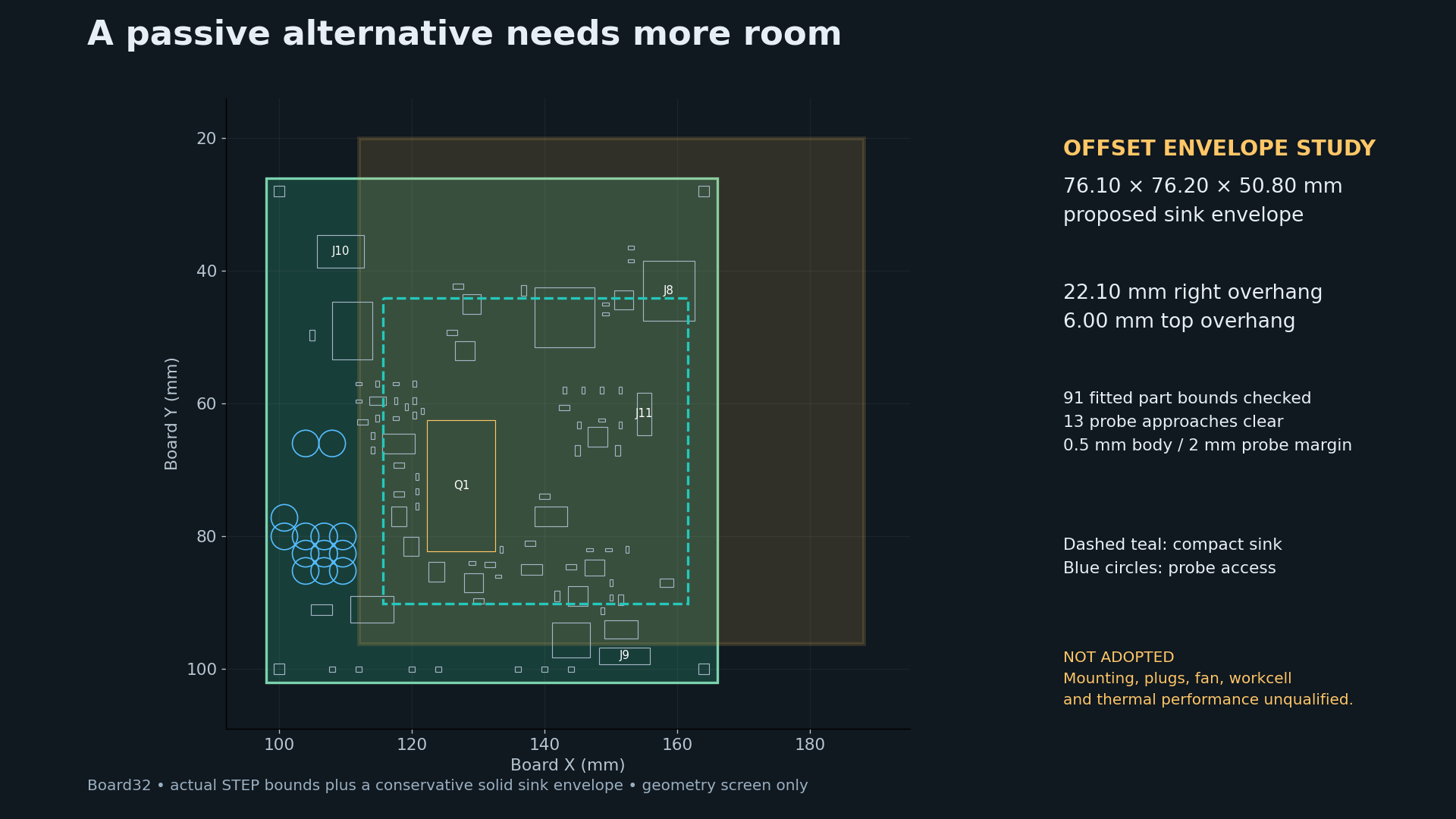
The existing fan starts 42 mm above PCB top copper, while this larger sink envelope reaches 58.05 mm. The current fan placement therefore overlaps the conservative sink envelope and cannot be reused as-is. Raising it would require a new carrier/harness study and would change natural-convection obstruction. Neither the nominal 1.5 K/W catalog value nor the fitted-board clearance result qualifies that assembly.
Plugged assembly continuation
The separate assembly study moves the candidate another0.5mm toward+X and- Y for connector clearance, raises the fan20.05mm and reroutes its three leads. The previous offset result remains an earlier bare-board-only search, not the latest assembly proposal. Manufacturer STEP geometry has also been found through the exact product page; local cut/registration review is separate from the original clearance model and does not grant redistribution rights.
# Passive cooling alternative screen
With the existing 5.5 W Q1 guard, 40 C ambient, 55 C case limit and provisional 0.52731 C/W interface/spreading budget, the sink must be at most **2.20 C/W**. This is a conditional allocation, not accepted thermal evidence.
Wakefield’s [2025 extrusion catalog](https://wakefieldthermal.com/content/catalogs/Thermal_Extrusions_WakefieldThermal-2025.pdf), printed page 5, gives natural-convection values for **three-inch specimens**, not arbitrary cut lengths:
| Stock extrusion | 76.2 mm cut envelope, W × H | Catalog C/W | Conditional case C |
|---|---|---|---|
| 125301 | 71.12 × 31.75 mm | 2.9 | 58.85 |
| 125313 | 73.025 × 33.325 mm | 2.3 | 55.55 |
| 125319 | 76.098 × 50.8 mm | 1.5 | 51.15 |
The larger option is worth a separate mounting study; it is not a drop-in replacement. A centered full-width base overlaps tall J9/J10 header bounds at the existing sink elevation. Offsetting or raising it changes contact/spreading and carrier geometry. Fan obstruction and the actual low-rise natural-convection performance remain unverified. Do not adopt the catalog number as an installed thermal result. No candidate is ordered or substituted into the BOM.
## Board32 offset-envelope follow-up
A fresh all-root STEP audit covers all 91 fitted models on Board32 with no unsupported transforms. A 0.5 mm grid search found 399 placements of a conservative 76.0984 × 76.2 × 50.8 mm solid sink envelope at the current 7.25 mm interface elevation that clear fitted component bounds with a 0.5 mm margin and all 13 vertical probe approaches with 2 mm radius. The lowest-overhang candidate spans board coordinates (112,20) to (188.0984,96.2) mm. It extends 22.10 mm past the right board edge and 6 mm past the top edge.
This resolves the earlier centered-envelope collision only in the stated geometric screen. It makes the complete module substantially wider and still needs mating-connector, wire, fan, carrier, source-spreading and workcell clearance checks. No mounting hole or fin geometry was invented and no assembly asset was replaced. The catalog resistance remains conditional at the low temperature rise of this project.
[Reproducible offset study](../tools/screen_board32_passive_offset.py) · [Input-bound results](../checkpoints/board32-temperature-bound/passive-offset-screen.json). This is a separate design alternative, not a thermal pass or accepted replacement.

The existing fan starts 42 mm above PCB top copper, while this larger sink envelope reaches 58.05 mm. The current fan placement therefore overlaps the conservative sink envelope and cannot be reused as-is. Raising it would require a new carrier/harness study and would change natural-convection obstruction. Neither the nominal 1.5 K/W catalog value nor the fitted-board clearance result qualifies that assembly.
## Plugged assembly continuation
The separate [assembly study](../mechanical/passive-assembly-study/README.md) moves the candidate another0.5mm toward+X and- Y for connector clearance, raises the fan20.05mm and reroutes its three leads. The previous offset result remains an earlier bare-board-only search, not the latest assembly proposal. Manufacturer STEP geometry has also been found through the exact product page; local cut/registration review is separate from the original clearance model and does not grant redistribution rights.